
Akagera National Park stretches across 1,122 km2 of eastern Rwanda along the Tanzanian border. The Kagera River feeds Lake Ihema and a chain of smaller lakes, papyrus swamps and floodplains, while open grassland, woodland and forest pockets cover the drier ground. Water occupies more than a third of the park, creating the largest protected wetland in central-eastern Africa and a landscape unlike Rwanda’s mountain rainforests.
This is Rwanda’s only protected savannah region and its only Big Five destination. More than 8,000 large mammals live across the park, including lion, leopard, elephant, black and white rhino, buffalo, giraffe, zebra and several antelope species. Almost 500 bird species add exceptional variety around the lakes, marshes, woodland and plains.
Akagera was established in 1934. Its wildlife declined sharply during years of conflict, settlement and poaching, but a new management partnership in 2010 began a sustained recovery. Seven lions returned in 2015, 18 eastern black rhinos followed in 2017, and five more arrived in 2019. Thirty southern white rhinos were introduced in 2021; that group had grown to 41 before a further 70 arrived in June 2025. A 120 km solar-powered boundary fence, ranger patrols, aerial surveillance, a canine unit and dedicated monitoring now protect the restored populations.
For travellers, Akagera completes the Rwanda safari experience. It brings together classic game drives, close water-level viewing on Lake Ihema and birding in papyrus wetlands within easy reach of Kigali. A day trip is possible, but one or two nights allow time for the park’s quieter northern plains, a night drive and an unhurried boat excursion.
Things to Do in Akagera National Park
Akagera can fit a short visit or a slower multi-day safari. Game drives reveal the wider landscape, a boat excursion brings you close to hippos and water birds, and overnight activities uncover the park after day visitors have left. Choose a few experiences that complement one another rather than trying to fit everything into a single day.
Game Drives in Akagera National Park
Game drives follow woodland, lakeshore and open-plain tracks between the wetter south and the broader northern grasslands. Early morning and late afternoon bring cooler conditions, softer light and more animal movement. Elephants, buffalo, giraffes, zebras, topis, Bohor reedbucks, Defassa waterbucks, oribis, impalas and elands are all possible, while lions, leopards, hyenas and rhinos require patience and good positioning.
A community guide can join self-drive visitors from the southern reception area. This is worthwhile on a first visit because the road network is extensive and recent animal movements shape the best route each day. Use a high-clearance vehicle throughout the year and a 4×4 during the wet season, when deeper tracks can become muddy.
Night Game Drives
Night drives are reserved for overnight guests and reveal wildlife that stays hidden during the heat of the day. Spotlights pick up bush babies, civets, mongooses, servals, hyenas and, with luck, leopard. The drive lasts about 2.5 hours and uses a park safari vehicle with a guide. It is a strong addition to a one-night stay because it changes both the pace and atmosphere of the safari.
Boat Safaris on Lake Ihema
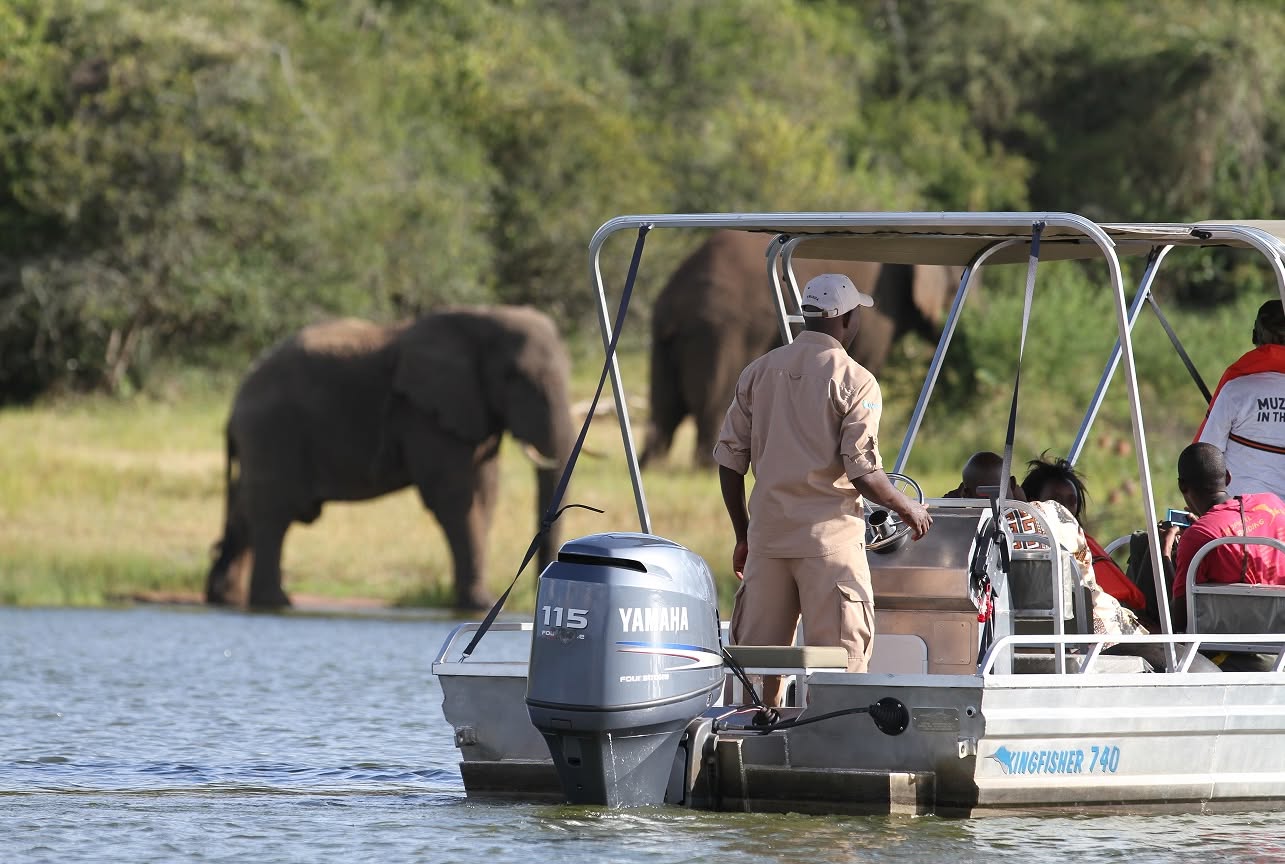
A boat safari on Lake Ihema places you at water level with hippos, crocodiles and dense concentrations of water birds. Elephants, buffalo and antelope also approach the shoreline to drink, giving the excursion a different viewing angle from the game tracks. Scheduled departures run at 7:30 am, 9:00 am, 3:00 pm and 4:30 pm. Morning trips suit birding and cooler weather, while the late-afternoon departure brings warmer light across the lake. Private trips can be arranged outside the scheduled times. Allow one hour for the boat itself and additional time to reach the departure point without rushing.
Boat Safaris on Lake Ihema
Bird Watching and the Shoebill
Akagera’s almost 500 bird species occupy sharply different habitats within one park. African fish eagles, open-billed storks, herons, egrets, cormorants, ibises and kingfishers gather around the lakes. Papyrus gonoleks, swamp flycatchers and blue-headed coucals favour the wetlands, while red-faced barbets, lilac-breasted rollers, grey hornbills, Ross’s turacos and raptors appear in the woodland and savannah. The shoebill is the most sought-after wetland bird, but it is never a guaranteed sighting. A boat trip and a slow drive along marsh edges give birders the best range of habitats in one day. Carry binoculars even on a general wildlife safari because much of Akagera’s character lies in the constant movement between water, reeds and open sky.
Fishing on Lake Shakani
Lake Shakani offers sport fishing for tilapia and catfish from the shore. Visitors bring their own equipment, and the catch can be cooked at the campsite. This works well as a quiet afternoon between longer drives, particularly for families or travellers staying more than one night. Arrange the activity before arrival so access and current conditions are confirmed.
Walking and Conservation Experiences
Walking experiences shift attention from large mammals to tracks, plants, insects, birds and the way the ecosystem fits together. The 7 km Walk the Line follows the park boundary with a fence attendant and takes about two hours, finishing on higher ground with broad views. The route lies outside the wildlife area and explains how the fence supports both conservation and neighbouring communities. Behind-the-scenes visits introduce the work carried out at park headquarters, while community experiences may include cattle traditions, milk and ghee preparation, banana-beer making or a visit to a honey cooperative. These activities are best arranged in advance because availability, minimum numbers and departure points differ.
Camping in Akagera
Four campsites provide simple overnight options inside the park. Muyumbu and Shakani lie about 15 minutes from the southern entrance. Muyumbu overlooks Lake Ihema, while Shakani sits beside Lake Shakani and has flushing toilets and solar-heated showers. Mutumba occupies high ground farther north, and Mihindi combines a northern campsite with a café near Lake Mihindi. Facilities remain basic, and equipment differs between sites. Confirm tent and bedding availability before travelling, bring food and personal supplies, and never move around camp after dark without following park instructions. Camping suits travellers who value location and atmosphere more than lodge comforts
Best Time to Visit Akagera National Park
Akagera is open throughout the year. The drier months from June to September and December to February make game tracks easier to use and concentrate animals around permanent water. Grass is shorter, visibility is clearer and full-day drives cover more ground, although the landscape can become dusty by late in the dry season.
Rain from March to May and October to November turns the plains green and brings strong birding, dramatic skies and fewer vehicles. Heavy showers can make some tracks difficult, so a 4×4 becomes important. Daytime temperatures remain warm, but early drives, boat trips and nights can feel cool. Pack light layers, rain protection, sun protection and enough drinking water in every season.
Where to Stay in Akagera National Park
Accommodation ranges from refined safari camps to park-run tented stays and basic campsites. Location matters because driving from the southern entrance to the wildlife-rich north can take several hours.
Choose the base around the route rather than price alone. Ruzizi or the game lodge works well for Lake Ihema and a short visit. Karenge or Magashi reduces the early drive to the northern plains. Combining a southern night with a northern night gives the park a natural south-to-north flow and avoids retracing long sections.
How to Get to Akagera National Park
Driving from Kigali to Akagera
Akagera’s southern entrance is about 110 km east of Kigali, and the drive takes around 2.5 hours without long stops. Leave Kigali past the international airport and continue through Rwamagana towards Kayonza. At the Kayonza roundabout, turn towards Kabarondo, then follow the signed road to the park. Search for Akagera National Park South Entrance or Giraffe Gate in your navigation app; a general park pin can lead towards the wrong part of this large reserve.
The southern entrance is the main point for day visitors and most self-drive arrivals. Complete the park formalities at reception before starting the game drive. Leave Kigali early enough to arrive near opening time, particularly on a day visit, because the best wildlife areas lie well beyond the gate.
Akagera works well as a one-way south-to-north drive when the northern gate is operating for exit. Confirm the gate arrangement before departure because access rules can change. Carry a park map, fuel the vehicle before entering, and download offline navigation; mobile coverage is not dependable on every track.
Helicopter Transfers to Akagera
A helicopter transfer from Kigali takes about 25 minutes, saving more than two hours of road travel. Scheduled services and private charters depend on availability, aircraft and weather. This option is most useful for short itineraries or stays in the northern concession, where the internal drive from the southern gate adds several hours.
Transfer flights and scenic flights serve different purposes. A transfer moves you directly between Kigali and the park, while a scenic flight is arranged for aerial views over the lakes, marshes and savannah. Confirm the landing point, luggage allowance, onward vehicle and any park landing charge before finalising the booking.
Combining Akagera with Other Rwanda Destinations
Akagera and Kigali
Kigali is the simplest pairing because the capital has a straightforward road connection with the southern entrance. Spend the first night in the city after an international arrival, then leave early for Akagera, or return after the safari for an easier flight connection. Museums, galleries, markets and dining add an urban counterpoint without creating a difficult transfer day.
Akagera and Nyungwe National Park
Akagera and Nyungwe bring together Rwanda’s strongest landscape contrast. Akagera offers open plains, lakes, Big Five wildlife and papyrus wetlands; Nyungwe replaces vehicle-based viewing with chimpanzee tracking, colobus monkeys, forest trails and the Canopy Walkway. This combination suits travellers interested in both mammals and primates, with Kigali or Lake Kivu providing a useful break between the long cross-country transfers.

Chimpanzee trekking in Nyungwe Forest National Park
Akagera and Volcanoes National Park
Akagera and Volcanoes National Park combine savannah wildlife with mountain gorilla trekking. Begin with game drives and a Lake Ihema boat trip, then travel through Kigali towards the Virunga highlands for gorillas, golden monkeys or a volcano hike. Reversing the order also works, but finishing in Volcanoes places the gorilla trek at the end of the journey. Allow a transfer day between the parks rather than compressing two major experiences into the same day.
Plan Your Akagera Safari with BLS Safaris
A well-paced Akagera visit balances one full game drive with a Lake Ihema boat safari and enough time to reach the northern plains. Stay overnight if you want a night drive, a relaxed camp experience, or a south-to-north route without racing the daylight. Share your travel dates, group size, and preferred comfort level, and the safari can be shaped around the best gate, accommodation, and activity sequence