
Serengeti National Park is the Tanzania safari you picture before you even arrive. Wide plains, golden grass, kopjes rising from the earth, big cats resting in the shade, and wildebeest herds moving across the horizon. The name comes from the Maasai word “Siringet,” meaning “wide, endless plain,” and once you stand out around Seronera, Ndutu, or the northern river country, you understand the name immediately.
The park covers about 14,763 square kilometres in northern Tanzania and sits within the wider Serengeti-Mara Ecosystem, one of Africa’s greatest wildlife landscapes. This is not a small fenced safari area. It is open, wild, and constantly changing. Rain, grass, water, and animal movement shape the experience, so every season offers a different Serengeti.
Serengeti National Park is best known for the Great Wildebeest Migration, one of the most dramatic wildlife movements on earth. More than 1.5 million western white-bearded wildebeest, around 250,000 Grant’s zebras, 400,000 to 500,000 Thomson’s gazelles, and smaller herds of eland move across the plains in search of fresh grazing and water.
This movement connects the southern Serengeti, central plains, western corridor, northern Serengeti and the Maasai Mara in Kenya. Depending on when you come, you may see newborn calves on the southern plains, long lines of animals crossing the grasslands, or the tense river crossings where crocodiles wait in the Mara and Grumeti rivers. But Serengeti is not only about the migration. Even when the great herds are in another part of the ecosystem, the park remains one of the best places in Africa for lions, leopards, cheetahs, hyenas, elephants, buffaloes, giraffes, hippos, warthogs and rich birdlife.

Game drives in serengeti
The central Serengeti was declared a game reserve in 1929 and became Tanganyika’s first national park in 1951. The Ngorongoro Conservation Area was later separated in 1959. Serengeti National Park became a UNESCO World Heritage Site in 1979 and a Man and Biosphere Reserve in 1982. Today, the park remains the heart of a wider ecosystem of about 30,000 square kilometres, connected to Ngorongoro, Maswa, Grumeti, Ikorongo, Kijereshi, Loliondo and the Maasai Mara. That connection is what makes the Serengeti feel alive. Animals are not kept in one corner for you to find. They move with the seasons, and we follow the rhythm of the land.
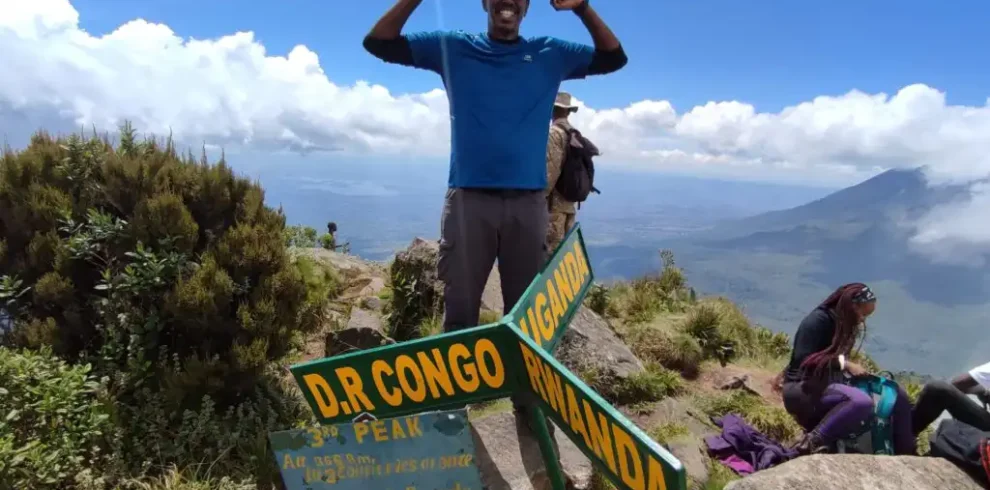
Seven-day premium Tanzania fly-in safari with mobile luxury camps that follow the Migration through the Serengeti. Light-aircraft transfers, hot-air balloon, exclusive private guiding.
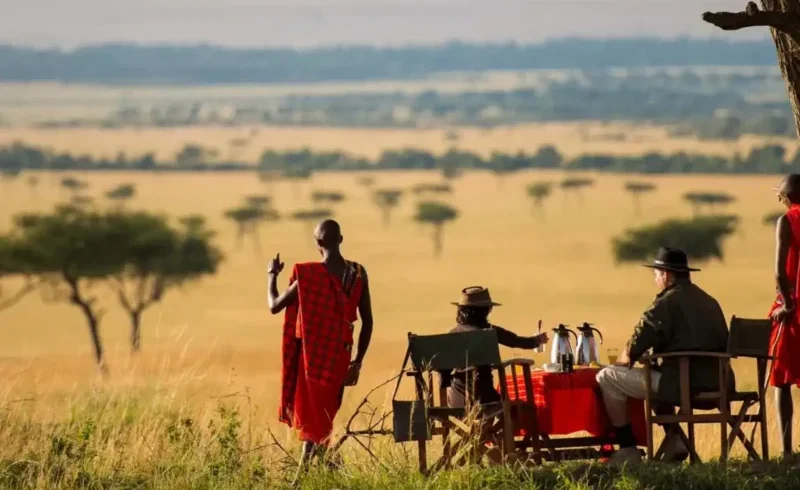
Six-day Tanzania safari following the Great Migration through the Serengeti — five game-drive days timed to where the herds actually are, plus the Ngorongoro Crater for Big Five close-outs.
Eight-day classic Tanzania Northern Circuit covering all four iconic parks — Tarangire, Lake Manyara, Serengeti and Ngorongoro Crater. The complete Tanzanian safari in one comprehensive trip.
Eleven-day Tanzania safari and Zanzibar beach combination — full Northern Circuit game drives followed by four nights on Zanzibar. The complete Tanzania experience.
Serengeti Wildlife and the Great Migration
A safari in the Serengeti feels big from the moment you enter. You are not watching wildlife in a small pocket of land. You are moving through open grass plains, riverine forests, wooded hills, seasonal pools, and granite kopjes, each one attracting different animals. The park itself covers about 14,763 km², while the wider Serengeti-Mara Ecosystem stretches across about 30,000 km² from northern Tanzania into Kenya’s Maasai Mara. That space is what gives the Serengeti its wild character. The animals follow grass, rain, water, and instinct, and your safari becomes part of that movement.The Great Wildebeest Migration in the Serengeti
The Great Migration is the Serengeti’s headline experience. More than 1.5 million wildebeest move with hundreds of thousands of zebras, Thomson’s gazelles, Grant’s gazelles and elands in search of fresh grazing and water. Around the southern Serengeti and Ndutu plains, the calving season can bring about 8,000 wildebeest calves in a single day. This is when the plains feel full of life. Newborn calves stand on shaky legs, mothers call through the herds, and predators move closer. Lions, cheetahs, hyenas, and jackals all follow the young and weak. Later in the year, the herds push towards the Grumeti River and then the Mara River, where the crossings become some of the most intense wildlife scenes in East Africa. There is dust, noise, hesitation, crocodiles in the water, and predators waiting on the banks. No crossing happens on command, but when it unfolds, it stays with you.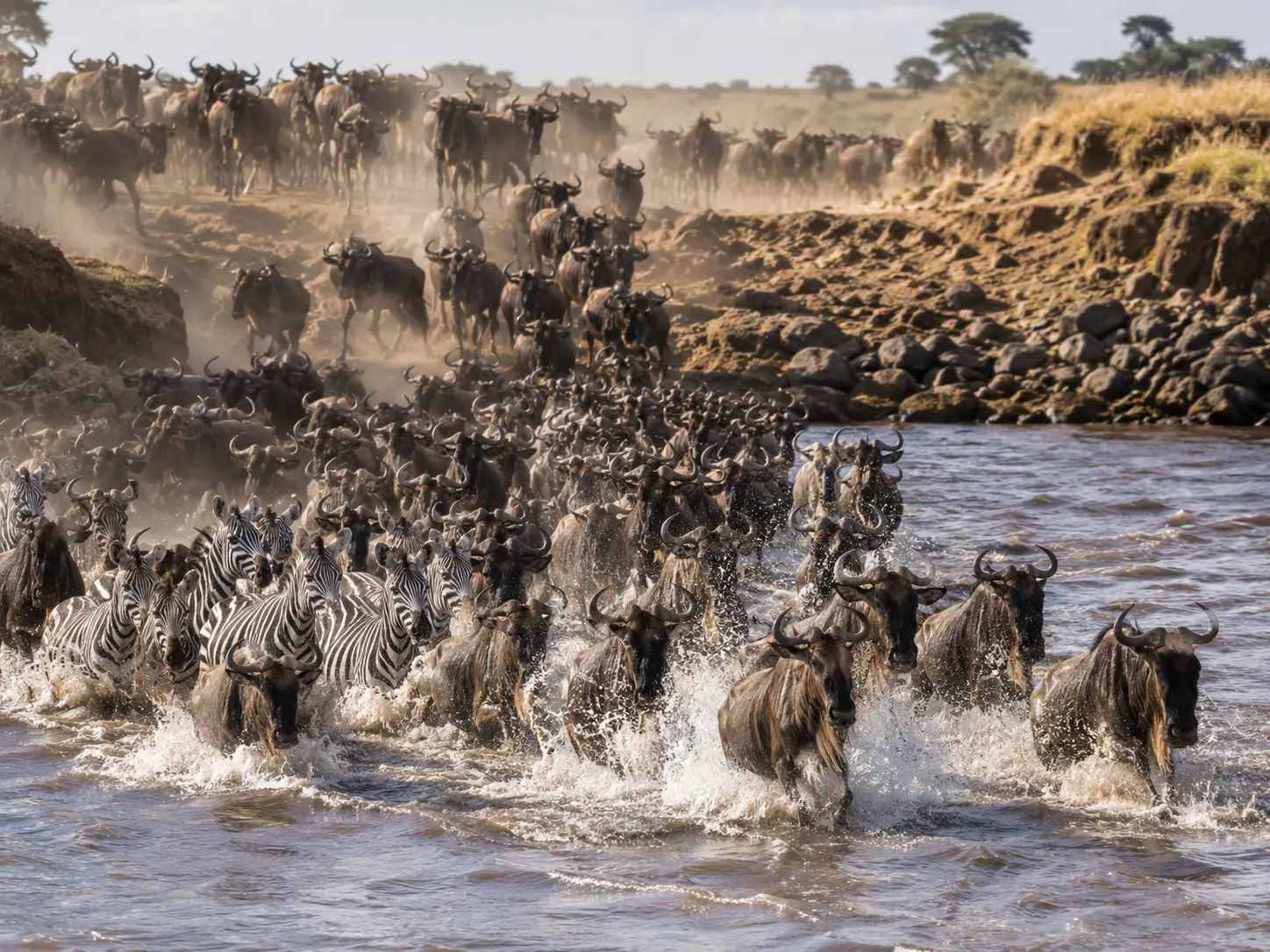
Wildebeest Great Migration Mara River Crossing
Big Five Animals in Serengeti National Park
Serengeti is a strong Big Five safari destination with lions, leopards, elephants, buffalo, and rhinos present. Lions are the easiest to see, and you may find them resting on kopjes, lying in the shade, or moving across the plains in large prides. Leopards are more secretive. We look for them around riverine forests, large trees, and rocky outcrops, especially in the Seronera Valley, one of the better areas for leopard sightings. Elephants move through woodland and open plains in family groups, while buffaloes can gather in large herds. Rhinos are present, but sightings remain rare because black rhinos are critically endangered and need patience, good guiding, and luck.Predators, Herbivores, and Smaller Wildlife
The Serengeti is famous for its predators. Lions, leopards, cheetahs, spotted hyenas, jackals, servals, and caracals all live here. Cheetahs prefer the open south-eastern plains where they can use their speed, while hyenas are powerful hunters in their own right and may move in clans of dozens of individuals. The herbivore life is just as impressive. Wildebeest, zebras, elands, topi, kongoni, impalas, Grant’s gazelles, giraffes, hippos, waterbucks, warthogs and buffaloes are all part of the Serengeti picture. Around kopjes and forests, you may also see olive baboons, vervet monkeys, black-and-white colobus monkeys, rock hyraxes, and different mongoose species.Birdlife, Reptiles, and Rare Species
Serengeti is also excellent for bird watching, with more than 500 recorded bird species. On the plains, look for ostriches, kori bustards, secretary birds, martial eagles, tawny eagles and bateleur eagles. You may also see Fischer’s lovebirds, rufous-tailed weavers, grey-breasted spurfowl, rollers, storks and swallows. Rivers and wetlands bring hippos, Nile crocodiles, herons, geese and other waterbirds. Across different habitats, you may also come across rock pythons, puff adders, black mambas, agama lizards and monitor lizards. Beyond the wildlife, the Serengeti carries a deep human story. Maasai, Sukuma, Kurya and Ikoma communities are connected to this landscape, while Maasai rock paintings, Gong Rock and Ikoma ruins add another layer to the journey.Where to Go in Serengeti National Park
Serengeti is huge, so where you go matters. The right area depends on the season, the wildlife you want to see, and how much time you have. Some places are best for big cats, others for calving, river crossings, quieter game drives or wider landscape photography.Central Serengeti and Seronera Valley
Central Serengeti is the best place to start if you want reliable wildlife viewing in almost any month of the year. The Seronera River Valley sits between the open southern plains and the wooded northern hills, so animals move through this area regularly. Here, you have strong chances of seeing lions, cheetahs, leopards, wildebeest, zebras, gazelles, giraffes, elephants, waterbucks, mongooses, and many resident animals. Early morning and late afternoon drives are especially good, as predators use the acacia trees, open plains, and riverine cover for hunting and resting. The Serengeti Hippo Pool near the Seronera River is also worth adding to your route. You can watch hippos packed together in the water, grunting, shifting and resting, with crocodiles and waterbirds sometimes seen along the banks.Southern Serengeti and the Ndutu Plains
Southern Serengeti is the place to be from about November to March, when huge herds of wildebeest, zebras, and gazelles move onto the short grass plains to feed and give birth. This is the calving season, and it brings some of the most active predator viewing in the Serengeti. Lions, cheetahs, leopards, hyenas, and jackals follow the young and weak animals, so game drives can be full of movement and tension. The southern plains are made up of rolling, tree-studded grassland, open horizons, and granite kopjes. It is a beautiful area for photography, especially when the plains are green and the herds stretch across the landscape.Western Serengeti, Grumeti River, and Grumeti Reserves
The Western Corridor is centred around the Grumeti River, which flows through the Mara Region of Tanzania towards Lake Victoria. This is a strong area around May and June, when migration herds move towards the river and begin the dangerous crossings. The Grumeti is known for large Nile crocodiles, hippos, riverbank wildlife, and predator activity. Lions, leopards, cheetahs, elephants, giraffes, and buffaloes may all be seen in this section. Nearby Grumeti Reserves give you a quieter, more private safari feel along the migration route. You can also find plains game, predators, and colobus monkeys in the riverine forest and more than 500 recorded bird species. In some private reserve areas, guided nature walks and night game drives may be possible where the rules allow.Northern Serengeti, Lobo Valley and Bologonja Springs
Northern Serengeti is quieter than the central and southern sections. It has green rolling hills, thicker vegetation, granite kopjes and strong year-round game viewing. This is the area to target around July and August, when the herds approach the Mara River and crossings may unfold. The Mara River crossings are among the most dramatic moments of the migration, with thousands of animals entering crocodile-filled water. You cannot schedule a crossing like an appointment, but staying in the right area gives you the best chance. Lobo Valley is another strong northern area for cats. Lions, cheetahs and leopards share the landscape with impalas, giraffes, warthogs, buffaloes, baboons, vervet monkeys, topi, hartebeests, dik-diks, rock hyraxes and elephants. Bologonja Springs adds a softer, greener stop in the north. Water attracts elephants, buffaloes, mountain reedbuck, steenbok and birds such as kingfishers, hoopoes and rollers.Eastern Serengeti, Moru Kopjes, Olduvai Gorge and Maasai Culture
Eastern Serengeti has open plains, valleys, mountains and granite outcrops, with fewer safari vehicles than many busier areas. It is also good for cheetah viewing during the February to March calving period. Moru Kopjes in central Serengeti are worth visiting for their rock formations, small pools, predator vantage points, elephants, giraffes, birds and historical rock paintings. These kopjes are not just beautiful. They are useful lookout points for predators, especially lions. For history, Olduvai Gorge near the Serengeti is known as the Cradle of Humanity, with fossil remains linked to early human evolution. Cultural visits around Maasai communities may include traditional dancing, village walks, school visits and handicrafts. The wider human story of this region also includes Sukuma, Kurya and Ikoma connections, plus places such as Gong Rock and Ikoma ruins.Best Time to Visit Serengeti National Park
Serengeti is a year-round safari destination, but the best time depends on what you want to experience. For dry-season game viewing and river crossings, June to October is the strongest period. For calving, bird watching, green scenery and fewer crowds, November to May gives you a softer but very rewarding Serengeti.

Best Time to Visit and Book a Safari in Serengeti national park
Dry Season in Serengeti National Park, June to October
The dry season is the most popular time to visit Serengeti National Park. The grass becomes shorter, the bush opens up, and wildlife is easier to follow across the plains. Animals gather around rivers and waterholes, so game drives become more focused. This is a good time for lions, cheetahs, leopards, elephants, buffaloes, zebras, giraffes and large antelope herds. Days are bright and sunny, with afternoon temperatures around 25°C / 77°F, although early mornings and nights can feel cold, dropping to around 14°C / 57°F. A warm layer is still worth packing. This is also the main season for dramatic river crossings.
From June, July, and August, migrating wildebeest herds move through the Grumeti River and later towards the Mara River as they head towards the Maasai Mara in Kenya. River crossings are never guaranteed on a fixed day, but this is the season when you have the best chance of seeing the tension, dust, noise, crocodiles, and predator action that make the migration so famous. From July to September, the northern Serengeti becomes busier around crossing points, so accommodation needs to be booked early. October remains good for wildlife as the plains stay dry and the last crossings may still happen in the north.
Wet and Green Season in Serengeti National Park, November to May
The wet season brings the Serengeti back to life. From November to December, short afternoon rains freshen the grasslands, clear the dust and improve the scenery for photography. The rain rarely lasts the whole day during this early green season, and wildlife viewing remains good as the herds begin moving back south. By January and February, southern Serengeti and the Ndutu Plains become the main focus as wildebeest, zebra and gazelle gather for calving. This is one of the most exciting times to be here because thousands of young animals are born, and predators follow closely.
Bird watching is also at its best from November to April, when migratory birds arrive from Europe and North Africa, and many resident birds are in breeding plumage. With more than 500 recorded bird species, this season is excellent if you want more than big mammals. From March to May, the long rains arrive, with April and May being the wettest and quietest months. Some camps may close, tracks can become more challenging, and game viewing may need more patience. But the park feels peaceful, rates are often lower, and the scenery turns beautifully green. For calving, birdlife, fewer safari vehicles and a softer side of Serengeti, the green season can be a very good choice.
Where to Stay in Serengeti National Park
Serengeti accommodation ranges from safari lodges and luxury tented camps to mobile migration camps, budget camps and a few private houses. The best place to stay depends on the season, the part of the park you want to explore and whether your focus is the Great Migration, big cats, quieter game drives, photography or family travel. Rates vary throughout the year, so there is rarely one fixed price for every season. The final cost depends on travel dates, room category, occupancy, meal plan and whether the lodge is booked as part of a complete safari itinerary.
How to Get to Serengeti National Park
Serengeti National Park sits in northern Tanzania within the wider Serengeti-Mara ecosystem. The route you choose depends on where your safari starts, which part of the park you are staying in, and whether you want a slower scenic journey or a quicker fly-in safari. Most Serengeti safaris start from Arusha, Kilimanjaro International Airport, Karatu, or Ngorongoro Conservation Area. Serengeti also combines well with Lake Manyara, Tarangire, Ngorongoro Crater and sometimes the Maasai Mara on the Kenyan side.
Getting to Serengeti by Road
Travelling by road gives you the full northern Tanzania safari build-up. From Arusha, the drive to central Serengeti around Seronera can take about 7 to 8 hours depending on road conditions, gate formalities and stops along the way. Many safaris break the journey with a night in Karatu or around Ngorongoro, then continue through the highlands, descend towards the open plains and enter Serengeti through Naabi Hill Gate. This route works well when your safari includes Tarangire National Park, Lake Manyara National Park or Ngorongoro Crater before Serengeti. The drive is long, but it is part of the experience. You pass villages, farms, Maasai grazing areas, crater highlands and changing landscapes before the plains begin to open out.
By the time you reach Serengeti, you already feel the shift from settled land into wild country. Road access is also useful when staying in the southern Serengeti, central Serengeti or Ndutu area during the calving season from around January to March. For the western corridor, Grumeti, northern Serengeti and Mara River areas, road journeys become longer, so many guests prefer flying unless the safari has enough nights to move slowly through the park.
Getting to the Serengeti by Air
Flying is the easiest way to reach the Serengeti when you want to save time, avoid long road hours or stay deep inside the park. Light aircraft flights connect Serengeti with Arusha, Kilimanjaro, Dar es Salaam, Zanzibar and other northern Tanzania safari destinations. Most flights land at small bush airstrips, and the right airstrip is chosen according to your camp, lodge or safari route. Seronera Airstrip is the main access point for central Serengeti, giving good access to year-round game viewing, the Seronera River Valley, big cats and many central camps.
For northern Serengeti and the Mara River crossing areas, flights use airstrips such as Kogatende or nearby northern access points. For western Serengeti and Grumeti, your safari uses western corridor airstrips. For southern Serengeti and Ndutu safaris, flights use airstrips closer to the short-grass plains during the calving months.
A fly-in Serengeti safari is best when time is limited, when you are staying in a remote luxury camp, or when your main aim is to reach migration areas quickly. You land close to the wildlife zones, meet your guide at the airstrip and begin game viewing almost immediately. Soft-sided bags are strongly recommended because the luggage limits on light aircraft are strict.
Serengeti National Park Travel Tips
Choose Your Serengeti Safari Area Before Choosing a Lodge
In Serengeti, your lodge location shapes the whole safari. Before choosing where to sleep, first decide what you want to see and when you are travelling. Central Serengeti and Seronera Valley are strong for year-round wildlife, big cats and easier access between game drives. Northern Serengeti is best for the Mara River crossing area, quieter rolling hills and kopjes. Southern Serengeti and Ndutu work well around the calving months, when wildebeest, zebra, gazelle and predators spread across the short-grass plains. Western Serengeti and Grumeti give you river scenery, crocodiles, hippos and a more remote safari feel. A cheaper lodge in the wrong area can cost you more in long transfers, missed game drives and tired days. A well-placed camp saves time and puts you closer to the wildlife you came to see.
Pick the Right Serengeti Accommodation Style
Serengeti accommodation ranges from budget camps and safari lodges to upper mid-range camps, luxury tented camps and rare private houses. Safari lodges feel closer to hotels, with more rooms, swimming pools and solid structures that often use local materials to blend into the wilderness. Tented camps give you the classic canvas safari atmosphere, where you still feel close to the bush. Luxury camps are usually smaller, more private and built for strong service, comfort and location. Private houses are rare in Serengeti and work well for families or small groups wanting their own space. Accommodation rates change by season, so always confirm what is included before comparing prices. Check whether your quote includes meals, park entry fees, airport or road transfers, guided activities and game drives.
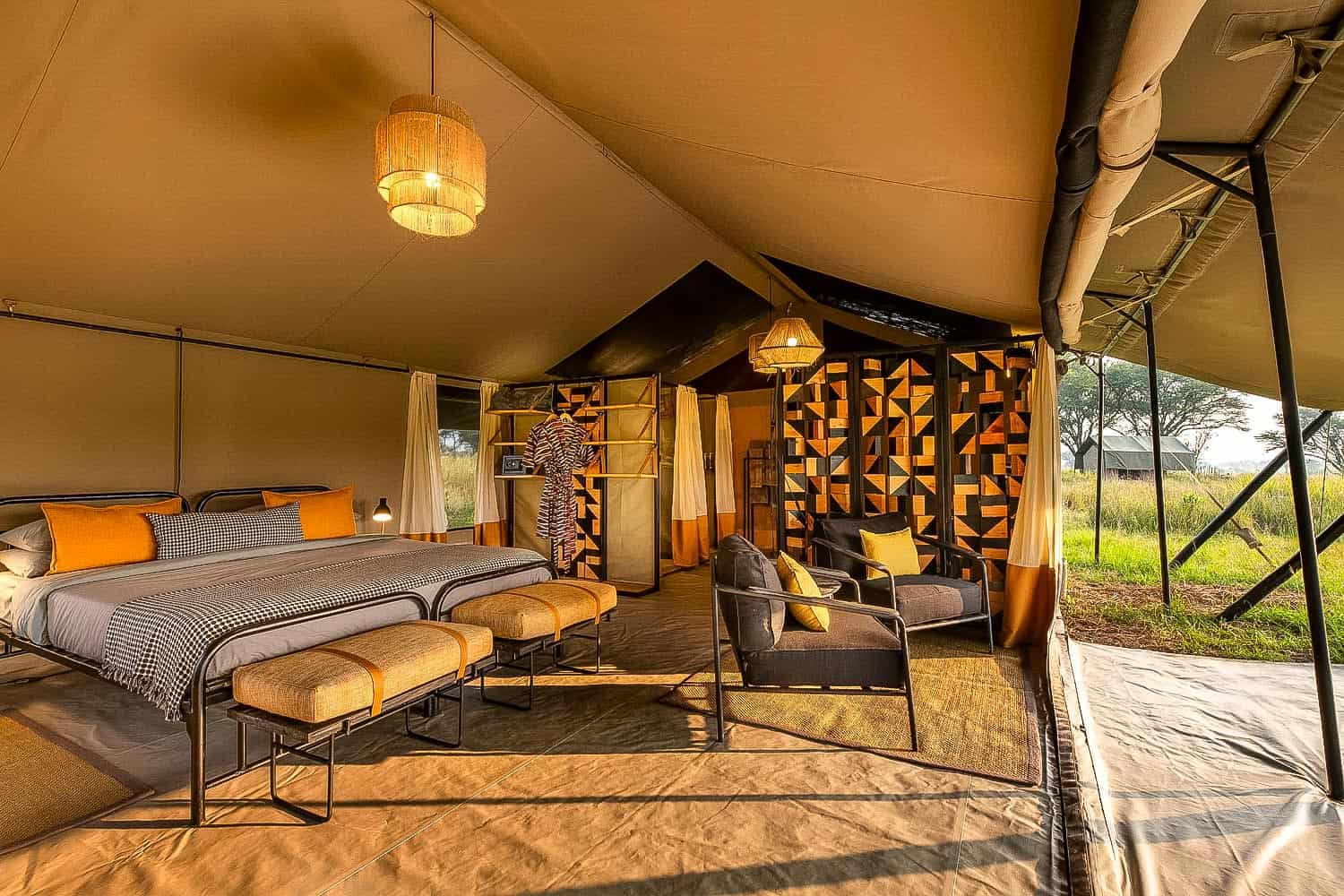
Ubuntu Migration Camp
Book Early and Check Park Access Before You Pay
Do not choose a camp by price alone. Some budget properties sit outside the park boundary, which means you enter and exit Serengeti for each game drive. That adds time, gate formalities, and less flexibility in the day. Camps in northern Serengeti, central Serengeti, and key migration areas fill early during river crossing months, calving season, and festive travel periods. If your safari depends on being in the right place at the right time, early booking matters. For fly-in safaris, pack soft bags because light aircraft luggage limits can be strict. For road safaris, allow enough time between regions, as the Serengeti is vast. A well-planned route gives you more time watching wildlife and less time rushing between camps.