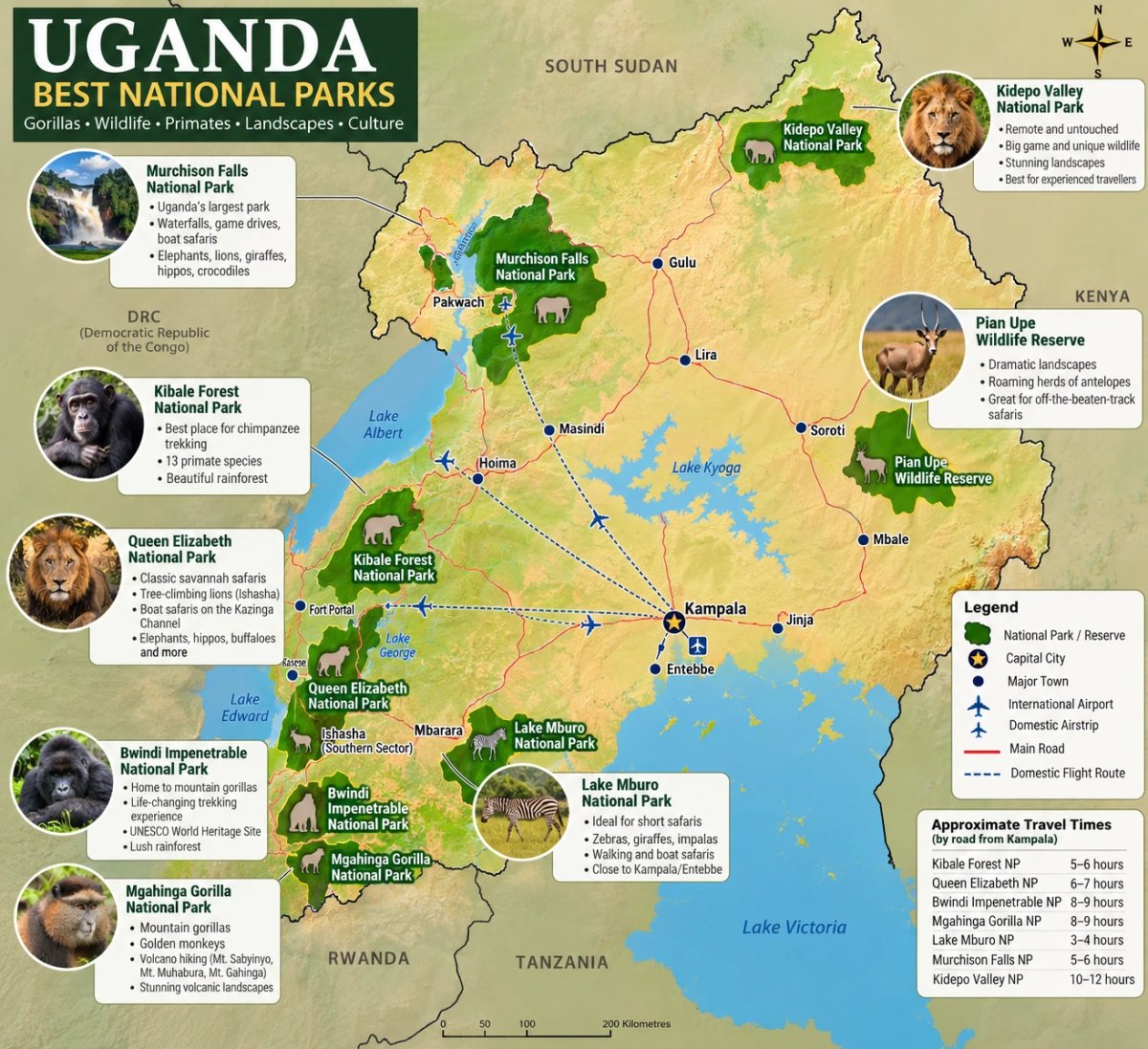
Uganda has 10 national parks , and the best national parks to visit on a Uganda safari depend on the experiences you want most. For gorilla trekking, look to Bwindi Impenetrable and Mgahinga Gorilla National Parks; for wildlife viewing and boat trips, consider Queen Elizabeth and Murchison Falls; for chimpanzee encounters, Kibale is a leading choice. Each offers a different way to explore the country.
Choosing the best national parks to visit on a Uganda safari can feel like a lot when you’re weighing wildlife, landscapes and travel time. This guide explains what each park is known for and how national parks differ from Uganda’s other protected areas, so you can focus your itinerary on the experiences that matter to you. We’ll cover gorilla trekking, savannah wildlife, river cruises and primate encounters, then show how the parks can fit together on a Uganda safari.
Key Takeaways
- Choose parks around your priorities: gorilla trekking, savannah wildlife, boat trips or chimpanzee encounters each point to different areas.
- Compare Bwindi and Mgahinga for gorilla trekking, then consider how either could fit alongside other park experiences.
- In Queen Elizabeth and Murchison Falls, plan time for both land-based wildlife viewing and river activities.
- Include Kibale if chimpanzee encounters are a priority, and allow your route to connect primate experiences with other wildlife areas.
- Look beyond national parks when comparing protected areas, since Uganda’s reserves and sanctuaries offer additional ways to shape a safari.
1. Mountain gorilla trekking in Bwindi and Mgahinga
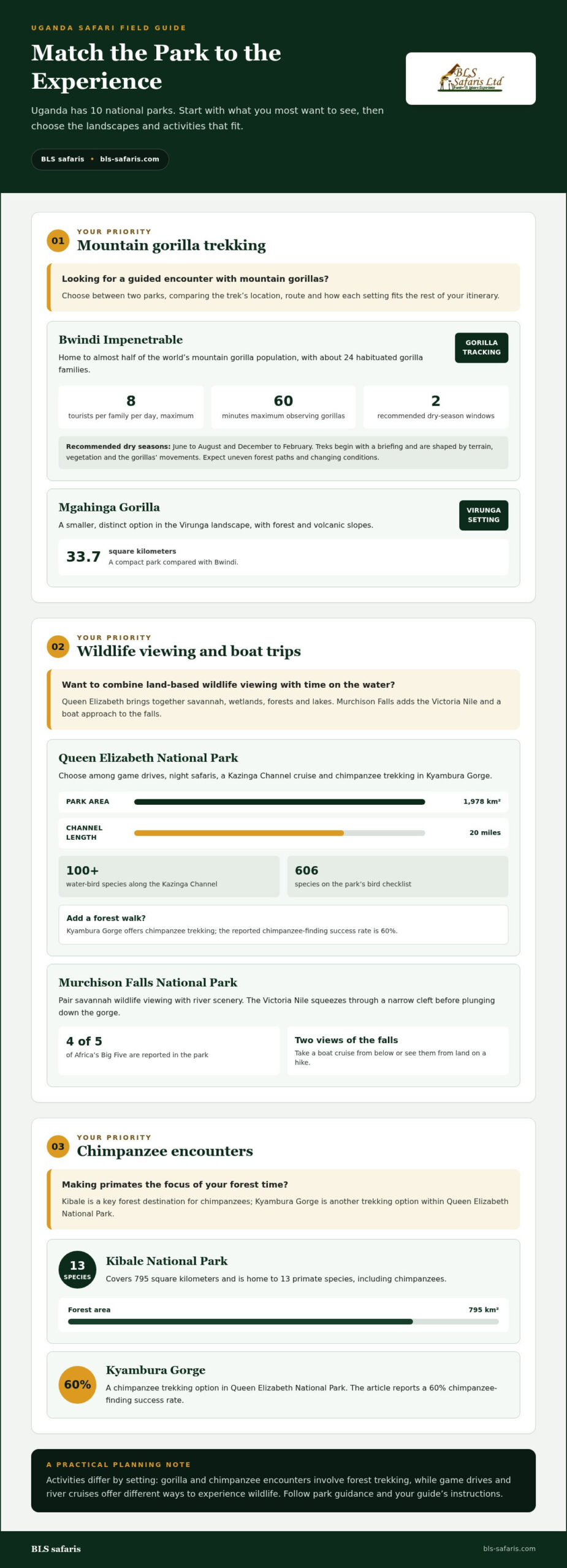
For mountain gorilla trekking, Uganda’s two national park choices are Bwindi Impenetrable National Park and Mgahinga Gorilla National Park. Bwindi is home to almost half of the world’s mountain gorilla population, while Mgahinga offers a smaller, distinct setting in the Virunga Mountains. Both parks offer guided tracking experiences, but their landscapes and routes differ.
Bwindi has about 24 habituated gorilla families, and each family can be visited by up to 8 tourists per day. That daily limit makes the family assigned to a trek an important part of the experience. Visitors can spend up to 60 minutes observing the gorillas once they find them. The walk itself can take longer and depends on where the family is located that day.
A typical trek starts with a briefing before visitors enter the forest with guides and trackers. The team searches for the assigned gorilla family, following signs such as nests, feeding remains and calls. Terrain, vegetation and the gorillas’ movements shape the trek, so wear suitable footwear and be ready for uneven forest paths. Stay with the group and follow your guide’s instructions during the encounter.
Habituation is the gradual process of helping a gorilla family become accustomed to people, allowing closely managed visits. Standard trekking focuses on finding a family that is already habituated. In Bwindi, the limit of 8 tourists per family per day helps explain why permits are planned around specific groups and dates. The chance to observe mountain gorillas is the central draw, not a general wildlife drive.
Mgahinga covers 33.7 square kilometres, making it a compact park compared with Bwindi. Its setting includes volcanic slopes and forest, and gorilla tracking here takes place in the Virunga landscape. Compare the parks by the trek’s location, route and the rest of your Uganda itinerary, rather than assuming the same terrain or travel plan applies to both.
The dry seasons recommended for gorilla trekking in Bwindi are June to August and December to February. Forest conditions still affect walking, so pack for damp ground and changing weather. The forest’s birdlife offers another reason to take time with the environment beyond the gorilla encounter. A cultural visit can complement the trek by bringing local heritage into the itinerary, such as a Uganda cultural visit.
2. Queen Elizabeth National Park wildlife and boat trips
The listed 2026-2028 entrance fee for a non-resident was USD 40 at Queen Elizabeth National Park, USD 45 at Murchison Falls, and USD 35 at Mount Rwenzori, Mount Elgon, or Semuliki. Fees for Kidepo Valley, Kibale Forest, and Lake Mburo were listed as USD 40. Follow park guidance and your guide’s instructions during wildlife viewing and boat trips.
Queen Elizabeth National Park covers 1,978 square kilometres, with savannah, wetlands, forests, and lakes supporting varied wildlife. A game drive gives you time to scan open grassland for African wildlife, while the Kazinga Channel offers a different view from the water. The channel stretches 20 miles and hosts more than 100 waterbird species, making a boat trip rewarding for birdwatchers as well as mammal watchers.
Plan a Kazinga Channel cruise when you want close views of waterbirds and animals gathering along the shore. Queen Elizabeth also offers night safaris, so you can choose between daylight drives, evening wildlife viewing, and a boat-based outing. The park’s bird checklist lists 606 species. Bring binoculars and take note of habitat changes, from the channel’s banks to open savannah.
For primates, Kyambura Gorge adds chimpanzee trekking to the park’s wildlife options. A reported chimpanzee-finding success rate for trekking there is 60%. Trekking is a different activity from a game drive or boat safari, so allow room in your itinerary for the forest walk and its distinct terrain. The gorilla forests of Bwindi offer another perspective on Uganda’s ecology, with flora researchers saying they have flourished for more than 25,000 years and have more than 200 butterfly species.
Murchison Falls National Park is another strong choice for wildlife and river experiences. It offers sightings of four of Africa’s Big Five, alongside boat trips on the Nile. Murchison Falls offers birdwatchers opportunities to look for birds between game drives and time on the water. A Murchison Falls Safari can complement Queen Elizabeth when your route includes both savannah and river landscapes.
Choose Queen Elizabeth for a mix of game drives, chimpanzee trekking, and the Kazinga Channel; add Murchison Falls for Nile scenery and wildlife viewing. To shape those park visits around your travel priorities, you can request a Uganda safari quote.
3. Murchison Falls, river cruises, and chimpanzee viewing
Murchison Falls National Park pairs savannah wildlife viewing with the Victoria Nile’s dramatic passage through the falls. The Victoria Nile squeezes through a narrow cleft before plunging down the gorge. A boat cruise lets visitors approach the falls from below, while a hike offers a land-based view. These activities give the park a different rhythm from a game drive across open grassland.
On the river, watch the banks for animals gathering to drink and birds moving along the water’s edge. The cruise also shows how the Nile shapes the surrounding habitat, contrasting river scenery with Murchison’s savannah. Plan it as a distinct activity rather than another drive, leaving time to enjoy the river and explore the park’s land-based wildlife areas.
For chimpanzees, Kibale National Park is a key forest destination. It covers 795 square kilometres and is home to 13 primate species, including chimpanzees. The forest experience differs from tracking mountain gorillas in Bwindi Impenetrable National Park: Kibale’s appeal is its concentration of primates and the chance to observe chimpanzees moving through their habitat.
Chimpanzee trekking in Kibale starts with a guided search through the forest. Trackers follow signs of chimpanzee activity while visitors listen and watch for movement in the canopy. The encounter may involve looking up through dense foliage, so patience and attention matter. Stay with your guide and follow instructions around the animals. This is a walking experience, not a vehicle-based safari.
Kibale is home to over 1,500 chimpanzees, and it also supports 12 other primate species. This diversity can make a forest walk rewarding even when chimpanzees are not the only focus. Look for other primates and notice changes in vegetation as the route passes through different forest areas. Kibale’s dry seasons for chimpanzee trekking are December to February and June to August.
Other forests can add variety to a Uganda itinerary, but Kibale is the clearest choice when chimpanzee tracking and primate diversity lead your plans. Combine it with Murchison Falls if you want to balance a forest trek with a Nile cruise and savannah wildlife. A Kibale chimpanzee tracking experience helps you explore the park’s primates within their forest habitat.
Kibale Forest National Park is described as having more primate species than any other park in Uganda and is inhabited by more than a dozen primate species. Its variety makes it a strong choice for a forest-focused experience, especially when paired with Murchison Falls’ river and savannah landscapes.
At Murchison Falls, the river rapids leading to the falls in Uganda extend for 80 km, and the waterfall is described as tumbling down 13 stories. A reviewer recommends spending at least 2 nights at Murchison Falls National Park to experience both the river and savannah areas. Another reviewer reported visiting Murchison Falls National Park for 3 days and 2 nights.
4. Murchison Falls and Nile River boat cruises
A Nile cruise at Murchison Falls National Park gives you a water-level view of the Victoria Nile and its surrounding wildlife. At the falls, the river rushes through a rocky gorge. Visitors can approach by boat or hike to a viewing point, making the falls a distinct stop within a park visit. The boat journey is also a wildlife-viewing experience, not simply transport to the waterfall.
Pair time on the water with a game drive to experience the park’s different habitats. A drive crosses savannah landscapes, while a cruise follows riverbanks where animals drink and birds forage. Murchison Falls offers sightings of four of Africa’s Big Five. Uganda’s national parks currently have no rhinos, so visitors cannot see all five in any one park.
Allow time in your itinerary for both activities. A river cruise focuses on the Nile and the falls, while a game drive explores the wider park. Visiting the falls involves a separate fee, whether you go by boat tour or hike. Keep this distinction in mind when planning: a falls visit is not the same as a general wildlife drive.
Queen Elizabeth National Park offers a different boat safari on the Kazinga Channel. The channel runs 20 miles and hosts more than 100 water-bird species. Compare the two waterways by the experience you want: Murchison’s Nile cruise centres on the falls and river scenery, while Kazinga’s cruise offers extended bird and wildlife viewing along the channel. Both can complement game drives without replacing them.
For a fuller Murchison visit, divide your time between land and river rather than choosing only one. Game drives offer broad views across the savannah, while a cruise brings you close to the Nile’s banks. Allow time for the falls viewpoint, too. This combination suits travellers looking for varied wildlife viewing, river landscapes and a waterfall in one destination.
Buffalo and climbing lions often come up in safari conversations, but choose Murchison for its mix of river scenery, savannah and four Big Five species. Never treat an endangered species encounter as guaranteed; focus instead on the habitats and activities the park offers. A Murchison Falls boat cruise can complement a game drive with a different perspective on the Nile.
5. National parks and other protected areas in Uganda
Uganda has 10 national parks, alongside other protected areas such as wildlife reserves, sanctuaries and community wildlife areas. That distinction matters: national parks are only part of the country’s conservation landscape, and the right choice depends on the experience you want, from forest trekking to savannah wildlife viewing.
Bwindi and Mgahinga are the mountain gorilla trekking destinations; Kibale is known for chimpanzees and other primates. Queen Elizabeth combines savannah wildlife, birdwatching and Kazinga Channel boat trips, while Murchison Falls pairs game drives with Nile cruises and the falls. In short, choose Bwindi or Mgahinga for gorillas, Kibale for chimpanzees, and Queen Elizabeth or Murchison Falls for a broader mix of wildlife and landscapes.
The best time to visit depends on the activity; no single season suits every park. The recommended dry seasons for gorilla trekking in Bwindi are June to August and December to February. For Queen Elizabeth wildlife viewing, January to February and June to July are recommended. In Kibale, the recommended dry seasons for chimpanzee trekking are December to February and June to August.
How long you need depends on the parks and activities you combine, plus the time needed to travel between them. A 10-day Mountain Gorilla Safari focuses on gorilla trekking, while a 12-day Ultimate Uganda Safari offers a broader itinerary; build the route around priority experiences rather than trying to fit every park into one trip.
Safety and health considerations vary with the activity, road conditions, terrain and wildlife encounters, so follow guide instructions and park rules. The U.S. Government Publishing Office reports that rebel and insurgent activities have been linked to national park occupation, poaching and illegal wildlife trade in Uganda. Include current security conditions in your travel planning.
Road transfers connect many park itineraries, and rough or uneven routes can make a 4×4 useful for reaching some areas. Domestic flights can reduce time spent travelling by road, while the best option depends on your route, schedule and the parks you plan to visit; for example, a multi-park trip must account for both transfer time and activities.
Protected areas beyond the 10 national parks can add different experiences, including community-based conservation and wildlife viewing in reserves or sanctuaries. Uganda’s national parks also vary in scale: Mgahinga covers 33.7 square kilometers, while Murchison Falls covers 3,840 square kilometers. Consider the contrast between forest and savanna, and look for species such as elephants, hippos and the many bird species recorded across the parks.
BLS safaris: East Africa Safaris
BLS safaris can help turn your park shortlist into a well-routed Uganda safari. Our Uganda Safaris bring together experiences such as gorilla trekking, wildlife viewing, river cruises and chimpanzee encounters, shaped around your priorities.
If you’re deciding between Bwindi, Kibale, Queen Elizabeth and Murchison Falls, thoughtful routing can balance forest visits, savannah drives and time on the water. BLS safaris plans tailor-made journeys with local guidance, clear routing, handpicked lodges and transparent pricing. For a wider regional trip, our East Africa Safaris can include Kenya or Tanzania.
Share the parks and experiences you’re considering, and BLS safaris can help shape a route around your travel plans. Get in touch to discuss your Uganda safari.
Plan a Uganda safari around what matters to you
Choosing the best national parks to visit on a Uganda safari is less about checking off every stop and more about deciding how you want to spend your days: on forest trails, enjoying unhurried wildlife viewing, or balancing both. Start with the experiences that matter most, then give the route room to connect them at a comfortable pace.
Your travel dates, preferred pace and appetite for road journeys can help shape the itinerary. If you’re considering more than one country, decide whether Uganda should stand alone or form part of a wider East African trip. Clear priorities make it easier to turn a shortlist of parks into a practical journey, with time for the places and activities you care about most.
As you plan, think about what you’d most like to remember and let that guide your choices. A thoughtful route can connect each part of the journey and leave you free to enjoy Uganda at your own pace.
Contact BLS safaris to plan your trip
Your Uganda adventure can begin with one simple decision: which experiences you want to make room for.
Frequently Asked Questions
How Many National Parks are in Uganda?
Uganda has 10 national parks. This is separate from its other protected areas, which include wildlife reserves, wildlife sanctuaries and community wildlife areas. For planning, treat each category as distinct: a national park itinerary can focus on destinations such as Bwindi, Kibale, Queen Elizabeth and Murchison Falls, while other protected areas may add different stops. The best route depends on which activities you want to prioritize.
What are the best national parks to visit on a Uganda safari?
The best national parks to visit on a Uganda safari depend on your interests and the route you want to follow. Bwindi and Mgahinga suit gorilla trekking, Kibale is a strong choice for chimpanzees, and Queen Elizabeth and Murchison Falls pair wildlife viewing with water-based activities. For a different focus, Kidepo Valley offers a more remote park setting. Choose a shortlist that fits your priorities and travel pace.
Which Uganda national parks are best for gorilla trekking and what are permit prices?
Bwindi Impenetrable and Mgahinga Gorilla National Parks are Uganda’s gorilla trekking destinations. Permit costs depend on the park, permit type and travel details, so include them in your overall safari planning. BLS Safaris’ tailor-made itineraries include permits, transport, lodging and meals, with transparent pricing and no hidden fees. Choose the park that suits your route, then request a personalized quote.
Where can you see the Big Five and other wildlife in Uganda?
Murchison Falls National Park offers sightings of four of Africa’s Big Five, while Queen Elizabeth is another option for savannah wildlife viewing and birdwatching. Uganda’s national parks currently have no rhinos, so no single park offers all five. For primates, consider Kibale for chimpanzees and Bwindi or Mgahinga for gorillas. Matching each wildlife priority to a park helps create a focused itinerary.
What are the safety, health, and travel risks when visiting Uganda’s national parks?
Gorilla treks can involve uneven forest paths, damp ground and changing weather, so suitable footwear and following your guide’s instructions are important. Rebel and insurgent activities have been linked to the occupation of national parks, poaching and illegal wildlife trade; the material gives no specific health risks.