The most independent-looking option isn’t always the easiest way to explore Uganda. In the self-drive vs guided safari in Uganda decision, self-drive suits travellers who want control over their schedule and feel comfortable managing the route. A guided safari can be simpler for first-time safari travellers. The right fit depends on how you weigh flexibility against local wildlife knowledge and help with driving and logistics.
It’s natural to weigh the freedom to stop when you choose against the reassurance of having an experienced guide along. Both approaches can make for a rewarding safari, but costs, wildlife knowledge, road conditions and navigation all affect which feels right for your trip.
This comparison explains how those factors shape your decision, where self-driving calls for more planning, and when a guided safari can make the journey easier. Use it to match your safari style to your confidence behind the wheel, travel priorities and plans in Uganda.
Key Takeaways
- Choose self-drive if you value setting your own pace and are comfortable managing routes, stops and trip logistics.
- Compare the full self-drive budget, including vehicle rental, fuel, accommodation and park fees, rather than focusing on one expense.
- A guide can help you notice wildlife signs and understand animal behaviour, adding context as well as support on the journey.
- Consider road conditions, navigation and your confidence driving in unfamiliar places before deciding how to travel.
- Use your group’s priorities, comfort behind the wheel and appetite for flexibility to choose the safari style that fits best.
Why Self-Drive in East Africa?
Self-drive offers more control over your itinerary, especially when a wildlife sighting changes your plans. In Uganda, that freedom also means taking responsibility for your pace, route choices and time behind the wheel.
Flexible Self-Drive Itineraries
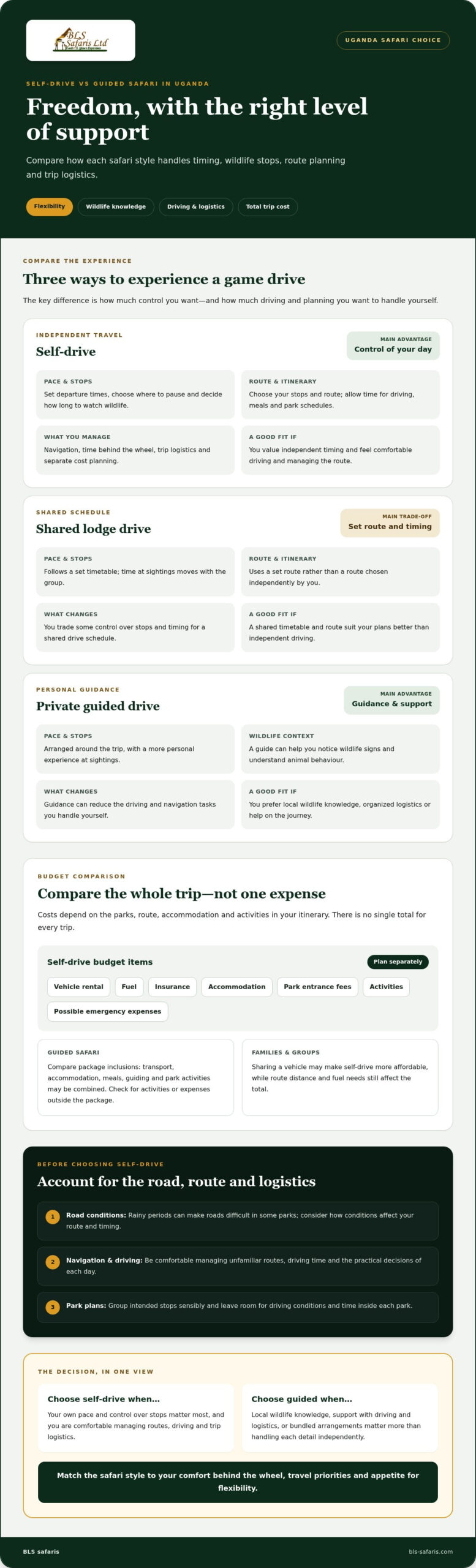
A self-drive safari lets you set departure times, choose where to pause and decide how long to watch wildlife. Unlike a shared lodge game drive, which usually follows a set schedule and route, your own vehicle gives you the flexibility to linger when animals appear or move on when you’re ready.
That flexibility can shape the whole safari experience. For example, photographers can spend longer composing shots at a sighting instead of following a group schedule. A very early start, such as 5 am, may also suit travellers hoping to be on the road at first light.
Independent travel also means handling the day’s practical decisions yourself. Allow time for driving between stops, meals and park schedules, rather than planning around wildlife viewing alone.
Parks and Routes for Self-Drive
Travellers can enter most East African parks without a guide, so Uganda’s national parks can suit independent trips. Choose a route based on the parks you want to visit, the time available for driving and your comfort on unfamiliar roads.
Which Uganda safari parks and routes are best suited to self-drive travellers? Self-drive is an option in most East African parks, including Uganda, without a guide. Group your intended stops sensibly and leave room for driving conditions and time inside each park.
For route planning, compare the practical trade-offs between a Uganda road safari and domestic flights. This helps you decide where independent driving supports your itinerary and where another travel mode could save time.
Photography also benefits from a flexible schedule, but equipment and patience matter. For self-drive photography in parks such as Etosha or Kruger, a 600mm lens or a 400mm lens with a teleconverter is recommended. Those examples show how photographers can plan for wildlife at a distance while allowing time to wait for a clear view.
| Option | Pace | Time at sightings | Itinerary control |
|---|---|---|---|
| Self-drive | Set your own schedule. | Stay as long as you choose. | Choose stops and a route. |
| Shared lodge drive | Follows a set timetable | Moves with the group | Uses a set route |
| Private guided drive | Arranged around the trip | Can be more personal | Balances guidance and flexibility |
Choose self-drive if independent timing matters most and you’re comfortable managing the route. If you prefer a shared schedule or want someone else to handle the driving, a guided game drive may fit better.
Self-drive safari costs for families and groups
Park entry, vehicle and activity fees depend on the parks and activities in your itinerary, so budget for each separately. Rainy-season roads can be difficult in some parks, making route planning and travel timing important for self-drive.
Budgeting and Safari Affordability
For self-drive, budget separately for vehicle rental, fuel, insurance, accommodation, park entrance fees and possible emergency expenses. Guided safaris can cost more, but packages may combine transport, accommodation, meals, guiding and park activities. Compare the total cost of these items, not just the vehicle, to see which option suits your group.
Self-drive may be more affordable for families or groups sharing a vehicle, although distance and fuel needs affect the total. A guided tour can suit travellers who prefer organised logistics and bundled services. Safari pricing depends on the itinerary, vehicle, accommodation and activities, with the trip-specific price provided in a personalised quote.
For an unforgettable trip that stays within your budget, list your destinations and planned activities first. Then compare what each option includes and what you’ll arrange separately. A quote for a tailored safari can help turn your preferred route and priorities into a trip plan.
Park, Vehicle, and Activity Fees
Budget separately for park entry, vehicle rental, fuel and insurance. Activities can also cost extra: guided activities arranged through lodges may be an additional expense on a self-drive trip. Booking them in advance can help secure a place.
There’s no single total for Uganda park entry, vehicle or activity fees across all itineraries. Costs depend on the parks you visit, how you travel between them and the activities you choose. Estimate expenses by park, then add vehicle and activity costs.
Rainy periods can make roads difficult in some East African parks. If you’re driving yourself, consider how those conditions affect your route and timing. Guided travel reduces the driving and navigation tasks, though your itinerary still shapes the experience.
Use this simple comparison before choosing:
- Self-drive: add vehicle rental, fuel, insurance, park fees, accommodation, and activities.
- Guided safari: compare the package inclusions with any activities or expenses outside the package.
- Families and groups: consider how sharing a vehicle changes the per-person budget, alongside the route’s distance.
Choose self-drive if you value control over arrangements and feel comfortable managing separate costs. Choose a guided safari if bundled logistics and support matter more to your group than handling each booking and expense independently.
Wildlife and local knowledge from a private guide
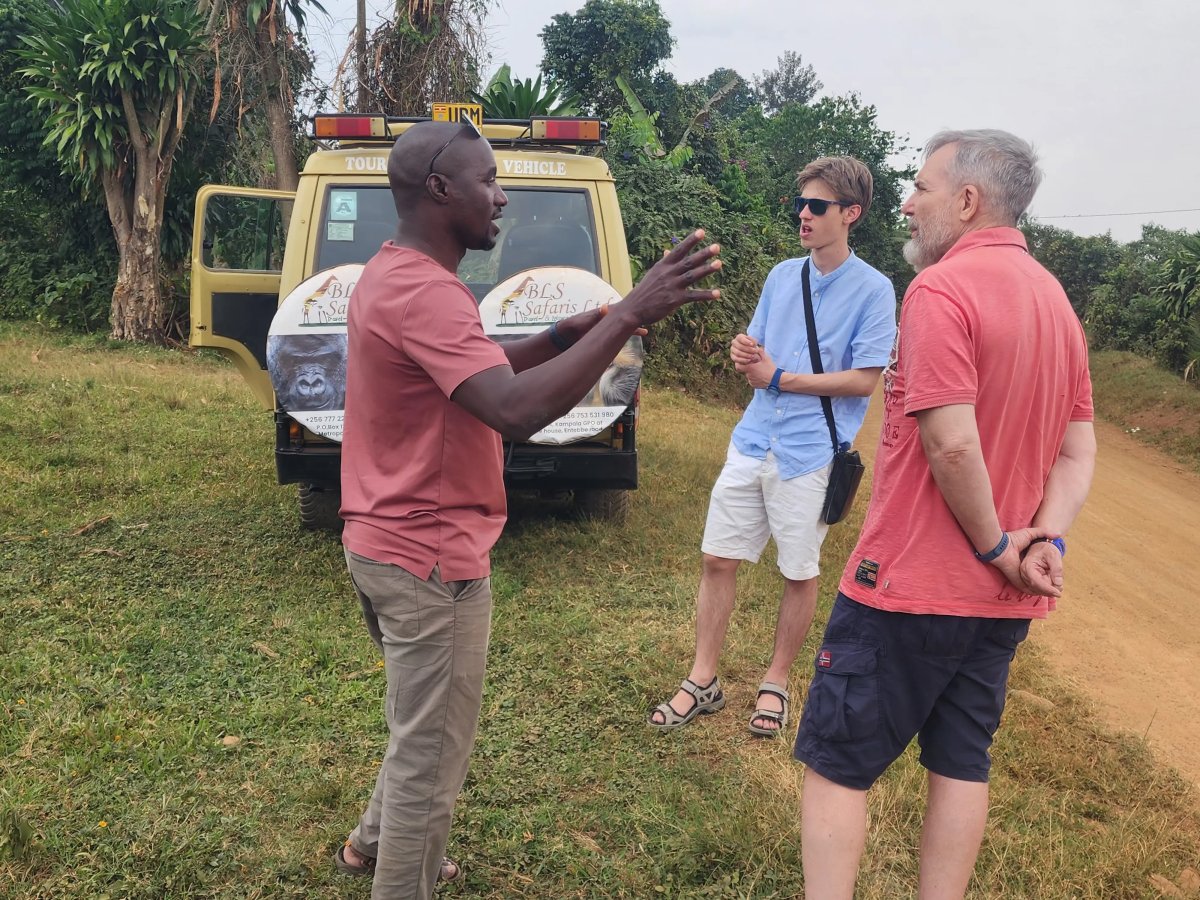
A private guide brings local wildlife knowledge to the drive, while self-driving leaves tracking and decisions to you. In Uganda, that difference can shape what you notice, how you respond to sightings and how much attention you can give the road.
Guides can read footprints, listen for bird calls and watch movement patterns to help locate animals. During game drives, they may also share updates with other guides about wildlife activity. A fresh track or alarm call can be hard to interpret without experience, while a guide can explain what it may signal and where to look.
That interpretation makes a sighting more than a photograph. A guide can share information about animal behaviour, local culture and history, adding context as you travel. In a private vehicle, you can discuss what you see at your own pace, rather than following a shared group’s questions and schedule.
Self-drive gives you control but also makes you responsible for decisions around wildlife. Elephants, buffaloes and hippos can become dangerous if approached incorrectly. Keep a safe distance, follow park rules and don’t let photography distract you from driving. Getting lost or focusing on a camera instead of the route can add stress when you’re responsible for both navigation and wildlife awareness.
Photography plans also affect how you prepare. A 600mm lens, or a 400mm lens with a teleconverter, is recommended for self-drive photography in parks such as Etosha or Kruger. Those examples show the value of reach when an animal stays far away. In Uganda, the broader lesson is to choose equipment that lets you photograph wildlife without leaving the vehicle or approaching too closely.
What permits and advance bookings are needed for gorilla trekking and chimpanzee tracking in Uganda? Gorilla trekking requires coordination of permits, transport, accommodation and park schedules, and mountain gorilla habitats are protected by strict regulations. Plan chimpanzee tracking as a separate activity in your itinerary, rather than assuming gorilla trekking arrangements cover it.
What driving rules, licences, insurance and vehicle requirements apply to visitors driving in Uganda? Self-drive travellers need a driver’s licence accepted in the destination country and must rent a vehicle. Include insurance in your budget, and be prepared to handle park maps, wildlife safety rules, fuel planning and rough roads.
A guide is especially useful if you want help interpreting tracks, calls and animal movement or would rather not manage driving and wildlife watching at the same time. Self-drive suits travellers who feel confident handling those responsibilities and value making their own decisions at each sighting.
Road conditions, navigation, and mobile coverage
In Uganda, self-driving adds route-finding and road conditions to your safari planning. A guided drive shifts those tasks to a driver familiar with the journey, while self-drive leaves you responsible for every turn and stop.
Road Conditions and Navigation
Some East African parks have unpaved roads and limited signage, and roads in some parks can become difficult during rainy seasons. On a Uganda route, study park maps before setting out and plan how you’ll navigate between stops. Weak mobile networks in remote areas mean phone-based directions may not always be available.
Save or carry the route information you need before leaving reliable mobile coverage. Note park entrances, accommodation locations, fuel stops and your intended route through each park. This preparation can help you avoid getting lost when signs are sparse or your connection drops.
Park driving demands more than map-reading. The driver needs to understand wildlife safety rules, fuel management and vehicle handling on rough roads. A route that looks direct on a map may take longer to navigate when unpaved sections or rain affect progress. Build flexibility into your daily plan instead of relying on fixed arrival times.
Mobile coverage matters most when plans change. In remote places, weak networks can limit access to live navigation or communication, so don’t rely on either as your only way to find the next stop. A printed map or offline route plan gives you another reference when the signal disappears. This preparation is useful whether your journey stays within Uganda or continues toward Tanzania.
Driving Challenges and Fatigue
Self-driving asks one person to watch the road, follow directions and make route decisions. That workload can become tiring after a long stretch, especially when rough surfaces demand steady attention. A guided safari reduces the driving burden, leaving you more time to watch the landscape and wildlife.
Plan the day in stages: check the route, identify a suitable stopping place and avoid packing too many distant destinations into one drive. If the road is slow or navigation takes longer than expected, adjust your plan rather than rushing to fit in every stop. This preserves flexibility without turning the journey into a demanding checklist.
Vehicle handling is another part of the decision. Rough roads call for careful driving, and a vehicle problem can complicate a remote journey. Recovery costs may add to your expenses, so consider whether you’re comfortable managing delays as well as driving the route. A guided arrangement removes much of that responsibility, while independent travel gives you more control over stops and timing.
Choose self-drive if you’re prepared to plan navigation, adapt to changing road conditions and manage your energy behind the wheel. Choose a guide if you’d rather focus on the safari while someone else handles Uganda’s roads and route decisions.
Choosing between self-drive and guided safaris
The right safari style depends on how you want to spend your time in Uganda. Weigh control over your itinerary against the value of local guidance, wildlife interpretation and support with travel logistics.
How do guided safari itineraries compare with self-drive options for wildlife viewing and flexibility? Self-drive gives you more control over stops and time at sightings, while a guided itinerary brings a driver and wildlife knowledge into the experience. Private guided trips can still feel flexible, unlike shared drives that follow set schedules and routes.
For a self-drive adventure, start by mapping the national parks you want to visit and the roads connecting them. Then decide whether you’re comfortable managing navigation, park timing, fuel and vehicle issues along the way. Most East African parks can be entered without a guide, but self-driving is less common in East Africa than in southern African destinations such as Namibia.
A guided trip can make more sense when you want help finding wildlife and understanding what you see. Guides can read tracks, listen for bird calls and share updates about animal movements. They may also coordinate transport, accommodation and park activities, letting you focus more on wildlife than on arranging each part of the journey.
Cost alone doesn’t settle the choice. Self-drive may be cheaper, particularly for families or groups sharing a vehicle, but the full budget includes rental, fuel, insurance, park fees, accommodation and possible recovery expenses. Guided packages can cost more while combining services such as transport, meals, accommodation, guiding and activities. Compare total trip expenses and inclusions, not just the vehicle or package headline.
Your comfort behind the wheel matters as much as your preferred pace. Choose self-drive if you enjoy planning, feel confident on unfamiliar roads and want to make spontaneous stops. Choose a guided safari if you’d rather not manage navigation and driving while watching for wildlife. On itineraries through remote areas, conservation zones or difficult terrain, professional guiding and organized logistics can be a practical advantage.
A hybrid approach can also work: drive independently on routes that suit your confidence, then choose guided activities that benefit from local interpretation. This preserves some flexibility without asking you to manage every part of the safari yourself.
Decision guide: Choose self-drive for personal control and a willingness to handle the details. Choose guided travel for wildlife insight and fewer driving tasks. For either option, base your decision on the parks, route, budget and experience you want, rather than assuming one style is always better.
BLS safaris: East Africa Safaris
BLS safaris plans tailor-made Uganda safaris and East Africa safaris , helping travelers shape a trip around their priorities. If you’re weighing independent travel against guided wildlife viewing, careful route planning can show how park visits, driving time and activities fit together.
Turn to BLS safaris for local guidance and clear routing on a Uganda journey, or when you’re considering a wider East African itinerary that includes Kenya or Tanzania. The team brings the practical pieces together to reflect the experience you want, whether wildlife, culture or a combination of interests.
Contact BLS safaris or visit bls-safaris.com to discuss your safari plans.
Shape your safari around the journey you want
For the self-drive vs guided safari in Uganda decision, start with the experience you want to bring home. Choose a wildlife priority, a preferred pace and the amount of driving you’re comfortable handling. Then shape the route around those choices, rather than building your trip around transport alone. A thoughtful plan can make room for independent exploration, guided wildlife experiences or a blend of both.
BLS Safaris can turn those priorities into a tailor-made itinerary. Our East Africa Safaris include Uganda Safaris and Kenya Safaris , giving you options for a Uganda-focused journey or a wider regional trip. Share the places and experiences that matter to you to define a route that suits your travel style.
With your priorities guiding the plan, you can look forward to a safari shaped around the way you want to travel.
Frequently Asked Questions
Can you plan a DIY safari road trip through East Africa?
Yes, you can plan an independent safari road trip, but you’ll need to coordinate the route, vehicle, accommodation, park visits and fuel. Start by choosing the countries and parks you want to include, then build a realistic driving itinerary between them. If you’re crossing borders, arrange vehicle and route details in advance, as border logistics and rental conditions can affect your plans.
Why choose a private guided safari?
A private guided safari pairs a dedicated guide with a more personal itinerary than a shared drive. You can discuss your interests, ask questions as wildlife appears and spend time on experiences that suit your group. For example, a birding-focused traveler can ask about calls and habitat during a drive. The guide handles the driving, leaving you more attention for wildlife and the surrounding landscape.
What are the pros and cons of self-drive versus guided safaris in Uganda?
Self-drive gives you control over your route and timing, but you’ll need to manage navigation, vehicle arrangements and road decisions. A guided safari brings a driver’s local knowledge and reduces those tasks, while following an itinerary arranged around the trip. In the self-drive vs guided safari in Uganda choice, consider whether independent adventure or supported wildlife viewing matters more to your group.
How much does a self-drive safari in Uganda cost, including car hire, fuel, park fees, and lodging?
The total depends on your route, rental vehicle, fuel use, accommodation, park visits and activities. Estimate each category separately: vehicle hire and insurance, fuel between destinations, lodging, park fees and any extra guided activities. Distance and vehicle type affect transport costs, while the number of travelers sharing expenses changes the per-person budget. Include a contingency for vehicle or route-related costs.
What are the road conditions, driving distances, and travel times between Uganda’s national parks?
Road conditions vary by route, and roads in some parks can become difficult during rainy seasons. Some park roads are unpaved, signage may be limited and remote routes can have weak mobile coverage. Plan each leg around the parks and accommodation on your itinerary, then allow flexibility for road conditions and stops. Don’t rely on map distances as a precise measure of driving time.
Is it safe to self-drive in Uganda’s national parks, and what risks should travelers plan for?
Self-driving requires attention to park maps, wildlife safety, fuel planning and vehicle handling on rough roads. Keep a safe distance from animals, as elephants, buffaloes and hippos can become dangerous if approached incorrectly. Factor difficult roads, limited signage, weak mobile coverage and possible vehicle problems into your plans. Don’t let photography or navigation distract you while driving through a park.
Are rental cars allowed in Uganda’s national parks, and is a 4×4 or local guide required?
Travelers can self-drive into most East African parks without requiring a guide, and rental vehicles are used for independent safari travel. A general requirement to use a 4×4 or hire a local guide does not apply across every park and route. Choose a vehicle suited to the terrain on your itinerary, and consider a guide if you want help with wildlife tracking, local interpretation or driving logistics.
When is the best season for a self-drive or guided safari in Uganda?
For a self-drive safari, plan around rainy periods, when roads in some parks can become difficult. Guided travel reduces the driving and navigation tasks, though your itinerary still shapes the experience.