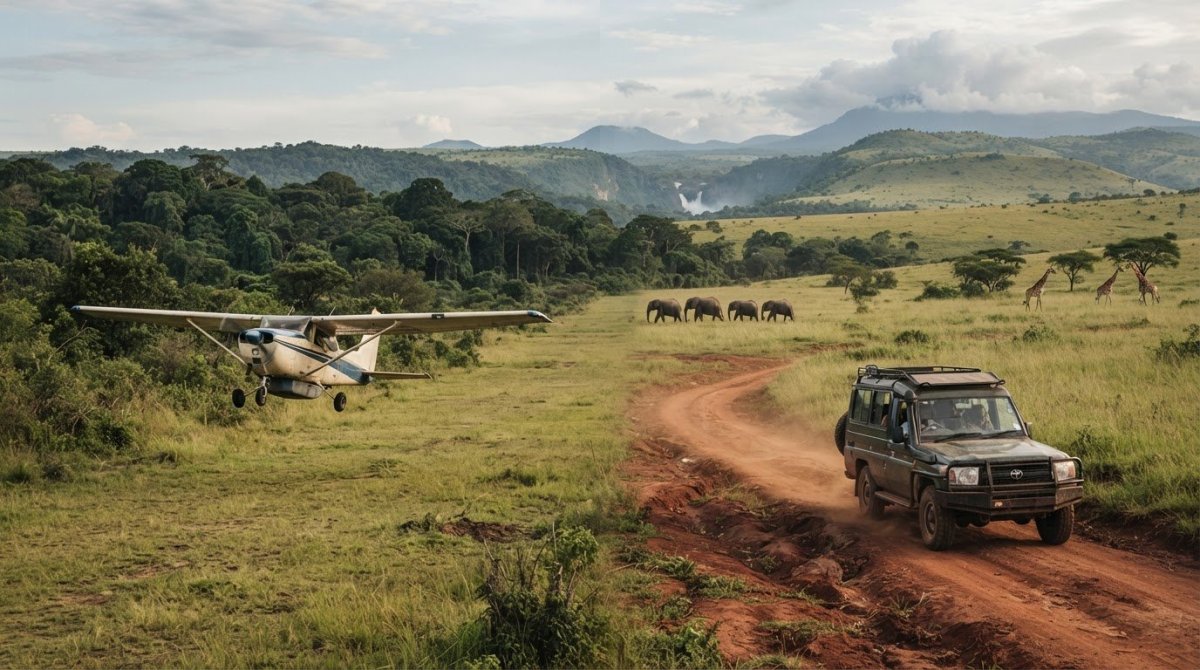
The quickest route isn’t always the best fit for your safari. In the Uganda Road Safari vs Domestic Flight comparison, flying saves time on long journeys: Entebbe to Murchison Falls takes about 1 hour by air, compared with 5-6 hours by road. Domestic flights use light aircraft to connect Entebbe with airstrips near major national parks, while driving keeps the journey on the ground between destinations.
It’s understandable to weigh travel time against the experience of the journey and its cost when considering Uganda Road Safari vs Domestic Flight. The right choice depends on how far you’re travelling, how much time you have, and whether flights serve the airstrips near your destinations.
This Uganda Road Safari vs Domestic Flight guide explains how Uganda’s domestic flights work, which safari routes they serve, when flying can leave more time for your safari, and how to compare flying with driving. It also covers luggage limits, flight schedules, and road transfers to help you choose an approach that suits your plans.
Key Takeaways
- Use the Uganda Road Safari vs Domestic Flight comparison to choose flights when reaching a distant park quickly matters most; compare the full journey, including transfers between airstrips and lodges.
- Look at which airstrips serve your intended parks, as routes and schedules shape which fly-in itineraries are practical.
- Allow for luggage limits and possible weather-related delays when deciding whether flying suits your travel style.
- Compare the flight fare with the overall driving plan, including vehicle and time considerations, rather than weighing fares alone.
- Use a combination of road and air travel where it best fits your route, available time, and priorities.
What are domestic flights in Uganda?
Uganda’s domestic flights use light aircraft to connect Entebbe with local airstrips near safari destinations. They offer an alternative to long road journeys, particularly for itineraries that include remote parks.
Access to Remote Safari Destinations
Domestic flights reach remote parks by landing at airstrips closer to wildlife areas, while road travel connects destinations overland. This difference matters when planning time in places such as Kidepo or Bwindi, where driving can take much of a day. Uganda has over twenty airfields, and local transfers connect airstrips with lodges and park areas.
Road journeys between Ugandan destinations can take 5-9 hours. From Entebbe, driving takes about 45 minutes to 1.5 hours to Kampala, around 2 hours to Jinja, and approximately 4 hours to Lake Mburo National Park. Murchison Falls National Park is about 5-6 hours away by road. Bwindi Impenetrable Forest takes around 8-9 hours, often with an overnight stop at Lake Mburo.
Flying shortens some of these journeys substantially. The Entebbe-Murchison Falls flight takes about 1 hour, while the flight from Entebbe to Bwindi takes under two hours. Light aircraft connect Entebbe with airstrips near major parks. Aero Link is one named domestic operator; routes and destinations depend on the scheduled services available for a given itinerary. A scenic flight is another way to consider Uganda from the air.
Entry planning is separate from domestic transport. Most international visitors can apply online for a Uganda e-Visa before arrival; according to the Directorate of Citizenship and Immigration Control, Uganda, single-entry tourist visas are typically valid for 90 days. The same authority says the East Africa Tourist Visa allows travel in Uganda, Kenya, and Rwanda for 90 days.
Road travel is affected by traffic jams and road conditions, while flights can be disrupted by weather, particularly at rural airstrips. Both options require careful planning for transfers and timing.
Rain can make rural roads harder to travel and slow overland journeys, while dry-season conditions can make some routes easier. The route, road surface, and current weather all affect driving time between destinations such as Entebbe and Bwindi.
Flight Reliability and Disruptions
Domestic flights can save hours, but weather may delay or disrupt services. Rainy-season conditions can affect take-offs and landings, especially at rural airstrips. If a flight is delayed or canceled, you may need to adjust onward transfers and park plans. Avoid tight connections between an airstrip arrival and a time-sensitive activity.
Scheduled domestic flights between Entebbe and national parks
Scheduled flights connect Entebbe International Airport with local airstrips serving Uganda’s major safari areas. Some routes also link parks, reducing the need to return to Entebbe between destinations.
Scheduled and charter flights serve Uganda safari destinations, including Murchison Falls National Park and Queen Elizabeth National Park, with airstrips also serving Bwindi and other park areas. Pakuba is within Murchison Falls National Park, while Ishasha and Mweya airfields serve Queen Elizabeth National Park.
Connections Between National Parks
Connecting flights move between regional airstrips, allowing an itinerary to continue from one park area to another. This matters when you want to combine distant wildlife destinations without repeating long road transfers. For example, a flight from Murchison Falls to Kasese takes about 1 hour, while Kasese to Kihihi takes about 2 hours and 15 minutes. Kihihi serves the Bwindi area, and some Entebbe flights stop at Kasese.
Light Aircraft Access to Parks
Domestic light aircraft use local airstrips rather than large international airports, bringing travelers closer to safari regions. Uganda’s charter aircraft range from 2-seater helicopters to 21-seater caravans. Scheduled services also connect Entebbe with airstrips near major national parks. Three named operators are Aerolink, Eagle Air, and Kampala Aero Club and Flight Training Centre; Eagle Air is one option within this domestic flight network.
Remote Parks Easier to Reach by Air
Flying is especially useful when a park is far from your arrival point, or you have limited time. Kidepo Valley and Bwindi are remote destinations where air access can reduce lengthy overland transfers. You’ll still need a road transfer from the airstrip to your lodge or park activity, so plan for both parts of the route.
Four operators run daily scheduled domestic flights between local airstrips and Entebbe International Airport. Flight frequency increases during peak tourism season compared with low season, so route timing can affect how you arrange park stays. Entebbe-Mbarara flights operate daily in mid-morning, except in April, May, and November. A Kihihi-Entebbe flight via Kasese takes about 1 hour and 10 minutes.
Road travel remains useful between parks and for reaching places without a convenient airstrip. It gives you a direct overland connection, while flights generally require ground transfers at both ends. For scheduled domestic flights, the stated luggage allowance is 15 kilos in soft-sided bags, including hand baggage; smaller aircraft may have stricter restrictions. Compare airstrip access, onward driving, and baggage needs before choosing a route.
For a journey that includes Queen Elizabeth National Park and Murchison Falls, map the air segments alongside road connections. A scenic flight in Uganda can also help you understand how air travel fits into a safari itinerary.
When domestic flights can reduce travel time
Flying makes the clearest difference on routes where road travel takes most of a day. Some Ugandan journeys lasting more than 10 hours by road can often be completed in under an hour by air. That shorter flight leaves more time for wildlife viewing rather than cross-country transfers.
Compare the full journey, not just time in the air. A domestic flight also involves reaching the departure airport, arriving at the destination airstrip, and continuing by road to a lodge or park activity. Travelers are advised to arrive at an airport or airstrip 60 to 90 minutes before departure. By contrast, a road transfer travels directly between stops, though driving time can vary with the route and conditions. For the Uganda Road Safari vs Domestic Flight decision, include these transfer and waiting times.
For example, remote Kidepo Valley National Park and Bwindi Impenetrable Forest are likely to require more than 9 hours of driving. The drive to either may take a full day, making air travel useful when the itinerary is tight. A traveler with seven days who hopes to visit Murchison Falls, Kidepo, and Bwindi may use domestic flights to reduce time spent travelling between regions.
Routes from Kampala also affect the choice. Major urban commercial cities in Uganda lie a four-to-eight-hour drive from Kampala, while the Entebbe-Kampala road transfer takes approximately 45 minutes to 1.5 hours, depending on traffic. For park journeys, weigh the road leg against the flight, airstrip transfer, and schedule. AeroLink flights may be delayed by weather, so a close connection can put later plans under pressure.
Aero Link Flights require travel documents, and luggage matters too. Foreign nationals should carry their passport on domestic flights; Ugandan citizens can use a national ID. The stated allowance is 15 kilos in soft-sided bags, including hand baggage, and smaller aircraft may impose stricter limits. Hand luggage limits are 12 inches high, 21 inches long, and 9 inches wide. On scheduled flights, passengers can book an additional freight seat for up to 75 kilograms of excess luggage.
For the Uganda Road Safari vs Domestic Flight comparison, weigh saved travel time against the route’s practical details. A light aircraft may shorten the journey, but baggage limits can affect what you bring and how you pack. A longer stay in fewer regions may suit road travel better, while a packed itinerary can benefit from flights.
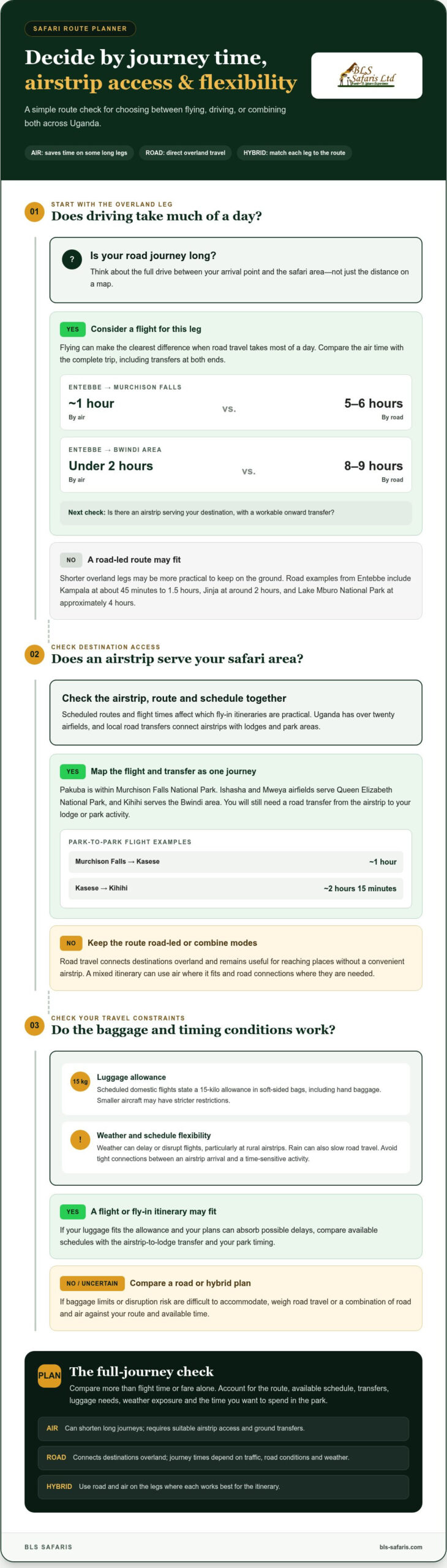
Comparing fly-in and driving safari itineraries
In the Uganda Road Safari vs Domestic Flight comparison, choose a road safari if you want to travel overland between stops and have time for the drives. Choose domestic flights when reaching distant parks quickly matters more than travelling the whole route by road. Many itineraries combine both, using aircraft for a long leg and vehicles for transfers and travel within parks.
A five-day safari itinerary using domestic flights is described as taking a minimum of nine days by road. This shows how transport can shape the itinerary, not just the time spent travelling. Flying may make a shorter schedule workable, while driving may suit a longer trip with fewer destinations or more time between them.
Consider the journey to Queen Elizabeth National Park. Kasese Airport is a 15-minute drive from the park, so a flight can bring you close to the area. The remaining transfer still matters: include the road journey from the airport when planning arrival times, lodge access, and activities. If your route includes another park, compare onward connections with driving between locations.
Road travel connects destinations overland, while a fly-in plan depends on aircraft routes and local airstrips. Murchison Falls National Park, Queen Elizabeth National Park, and Bwindi can fit into a combined itinerary when flight legs and ground transfers align. Charter flights offer another routing option, but aircraft arrangements and baggage capacity affect how the journey works.
Luggage is a practical difference between the two approaches. Domestic flights have a stated allowance of 15 kilos in soft-sided bags, including hand baggage, and smaller aircraft may have stricter limits. By road, you don’t need to fit your bags within an aircraft allowance, although luggage still needs to travel comfortably in the vehicle. Pack around the transport mode used on each leg.
Weather matters when comparing the options. Rainy-season conditions can affect take-offs and landings, particularly at rural airstrips. Allow flexibility in a flight itinerary in case disruption affects transfers or activities. Weather can also affect road conditions, so avoid planning a tight arrival followed by an immediate activity.
For travellers making the Uganda Road Safari vs Domestic Flight choice in Uganda, the best fit depends on trip length, park sequence, and time available for transfers. A longer stay can make driving between national parks more manageable. A short visit covering distant areas may benefit from flying, especially when an airstrip is close to the intended park.
Before choosing, map each leg from your starting airport to the park, including the onward road transfer. Compare the five-day fly-in itinerary with its minimum nine-day road equivalent, then decide whether the extra days suit your plans. This helps you weigh travel time, route flexibility, luggage needs, and the pace you want.
Domestic flight costs
Treat this as the fare for one leg, not the total cost of reaching a park and returning. A route with several air segments can involve multiple fares, while a one-way flight followed by a road transfer has a different cost structure. Compare the complete route before deciding.
The price of an individual flight depends on the route and aircraft arrangement. A scheduled seat and a charter flight suit different travel needs, and charter aircraft vary in size. Eagle Air is among the domestic operators serving Uganda. For a trip to Bwindi Impenetrable Forest, factor in the onward transfer from the destination airstrip.
Extra luggage can add to the flight bill. Scheduled domestic flights have a stated allowance of 15 kilos in soft-sided bags, including hand baggage, and smaller aircraft may impose stricter limits. If you’re travelling with gorilla-trekking gear, account for the allowance and any additional baggage before comparing fares.
Driving has a different cost structure. Rather than paying a flight fare for each leg, road travel involves the vehicle and distance covered. The overall comparison depends on the parks on your route, the number of transfers, and whether you use a vehicle throughout or combine road and air. For example, a route joining Murchison Falls and Bwindi may involve several long road transfers or a mix of flights and driving.
Compare the full transport costs. Include the flight fare, luggage charges, ground transfers, and any road sections needed to reach a lodge or park activity. Then compare these with the vehicle and route requirements of the road itinerary. A fare that looks attractive for one leg may not reflect the full transport cost of a multi-park journey.
The wider Uganda safari price depends on the itinerary and its cost factors, including transport choices, route, accommodation, and activities; it is provided after a quote request. Keep that total separate from the per-person domestic flight fare, so you can see which costs belong to air travel and which belong to the broader safari plan.
For a clear comparison, list each destination in order and mark every flight, transfer, and road leg. Add the per-person flight fares and any applicable excess-luggage charge, then compare the transport plan with driving between the same parks. This makes the trade-off easier to assess for a gorilla visit in Bwindi, a wildlife stay elsewhere, or a route combining both.
BLS safaris: East Africa Safaris
BLS safaris can plan an itinerary around the parks you want to visit and how you prefer to travel. Our Uganda Safaris can combine road transfers and domestic flight legs in one route, with local guidance, clear routing, and handpicked lodges included in the planning.
If your journey extends beyond Uganda, East Africa Safaris can include destinations in Kenya or Tanzania. This can help you weigh park connections, available travel days, and the pace you want across the region. The aim is to fit transport choices to the overall journey rather than consider each flight or drive in isolation.
Contact BLS safaris to plan your route, or visit bls-safaris.com.
Shape a safari around the journey you want
The Uganda Road Safari vs Domestic Flight choice shapes the character of your trip, not just how you get around. Think about how you want the days between parks to feel: an overland journey, a quicker transfer, or a considered mix of both. That preference can guide your itinerary before you settle each travel leg.
BLS Safaris plans Uganda Safaris and East Africa Safaris, including journeys that connect Uganda with Kenya. Share the parks you hope to visit, your available travel time, and whether you prefer more time on the road or in the air. Those priorities provide a clear starting point for your itinerary.
Contact BLS safaris about your trip
With your priorities in view, you can build a coherent journey from arrival to departure. A thoughtful route leaves room to enjoy each destination at your own pace.
Frequently Asked Questions
How long does it take to travel by road between Uganda’s main safari destinations?
Road transfers between Ugandan destinations commonly take 5-9 hours, depending on the route. For planning, treat each park transfer as a substantial part of the day, not a short connection between activities. Stops, traffic, and road conditions affect the schedule. If your itinerary includes distant areas such as Bwindi and Murchison Falls, consider how much time you want to spend travelling versus staying in each park.
What are typical domestic flight routes and flight times to Uganda safari parks?
Flights link Entebbe with local airstrips serving parks, including Pakuba in Murchison Falls National Park and Ishasha and Mweya for Queen Elizabeth National Park. Entebbe to Murchison Falls takes about 1 hour by air. Flights also connect park regions: Murchison Falls to Kasese takes about 1 hour, and Kasese to Kihihi takes about 2 hours and 15 minutes. Transfers from airstrips complete the journey.
How much do Uganda safari road transfers and domestic flights cost?
There is no single transport total for every Uganda safari route. Flight costs depend on the route and service provider, whether you take scheduled or charter services, and your baggage needs. Road-transfer costs depend on distance, vehicle arrangements, and itinerary length. Compare the full transport plan, including air legs, airport or airstrip transfers, and road sections. This gives you a more useful Uganda Road Safari vs Domestic Flight budget comparison than considering one flight or drive in isolation.
How do road safaris and domestic flights compare for comfort, scenery, and wildlife viewing?
Road travel keeps you on the ground between destinations and lets you include planned stops along the way. Flying reduces time in transit, but you’ll still need ground transfers after landing. Neither option replaces wildlife activities in parks such as Queen Elizabeth National Park. In the Uganda Road Safari vs Domestic Flight comparison, choose based on whether you value an overland journey or a quicker connection, then allow time for game drives or other park experiences.