Amazing Tarangire National Park Wildlife: What Animals Can You See on Safari? Tarangire National Park is about 140 kilometres from Arusha by road, and the drive takes about three hours. Its wildlife is closely tied to the river, seasonal swamps, open grassland, and baobab-dotted landscapes. In the dry season, animals gather near the Tarangire River as water becomes scarce.
It’s understandable to focus first on the route and the chance of seeing elephants, lions, or other familiar safari animals. But Tarangire National Park wildlife is shaped by the park’s habitats and seasons. From June to October, animals gather around the river as water becomes scarce, while the wet season offers excellent birdwatching.
This guide explains how to reach Tarangire from Arusha, which mammals and birds live in the park, and how baobabs, swamps, and other habitats shape the experience. You’ll also learn how seasonal movement affects sightings, so you can plan around the wildlife and landscapes you most want to discover.
Key Takeaways
- Learn which large mammals are commonly seen and which unusual antelope species make the park distinctive.
- Understand how seasonal wildlife movement shapes elephant sightings around the Tarangire River.
- Discover how baobabs, sausage trees, and termite mounds add to the park’s natural character.
- Explore how swamps, grasslands, and other habitats influence wildlife viewing across the park.
- See how a Tanzania safari can fit Tarangire into a wider East African journey.
Where is Tarangire National Park?
Tarangire National Park lies in northern Tanzania, about 120 kilometres southwest of Arusha. By road, the journey from Arusha is about 140 kilometres and takes around three hours. Its position makes the park a natural stop on a northern safari circuit, alongside destinations such as Serengeti and Ngorongoro.
Tarangire National Park Wildlife and Seasonal Viewing
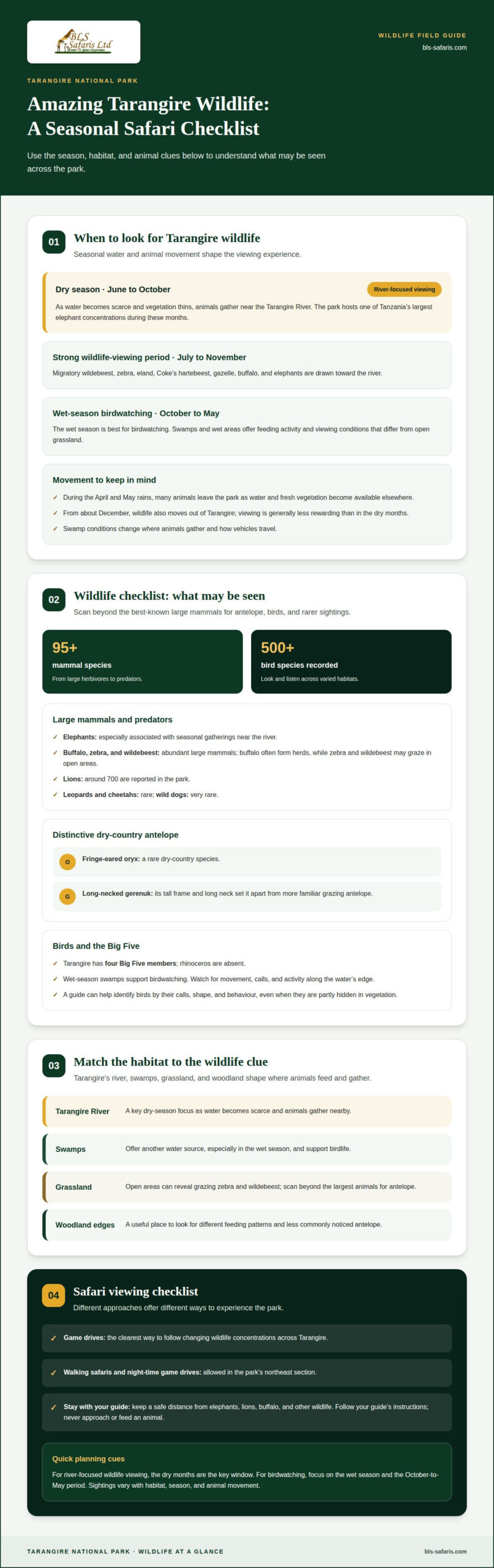
Dry-season wildlife viewing centres on water. From June to October, water becomes scarce, vegetation thins, and animals gather near the Tarangire River. During these months, the park hosts one of Tanzania’s largest elephant concentrations. July to November is a particularly strong period for wildlife viewing, as migratory wildebeest, zebra, eland, Coke’s hartebeest, gazelle, buffalo, and elephants are drawn toward the river.
Seasonal movement changes what visitors may see. Many animals leave the park during the April and May rains, when water and fresh vegetation become available elsewhere. From about December, wildlife also moves out of Tarangire, and viewing is generally less rewarding than during the dry months. Swamps offer another water source, especially in the wet season, and their changing conditions affect where animals gather and how vehicles travel.
For a broad chance of seeing wildlife around the river, plan for July to November; June to October is the dry-season window. The wet season is better for birdwatching, with October to May among the best months. Tarangire has four of the Big Five members, while rhinoceros are absent. Compared with Serengeti and Ngorongoro, its defining draw is seasonal wildlife gathering around the river and swamps. Each park offers a different landscape and viewing experience. Travelers comparing habitats across the region can also explore Uganda safari packages for gorilla trekking and wildlife.
Game drives are the clearest way to follow changing wildlife concentrations across Tarangire. Walking safaris and night-time game drives are allowed in the park’s northeast section, adding different ways to experience its wildlife. The best option depends on the season, areas included in the itinerary, and whether you want to focus on daytime sightings or other encounters.
Tarangire is home to potentially dangerous animals, including elephants, lions, and buffalo. Keep a safe distance, stay with your guide, and follow their instructions around wildlife. Never approach or feed an animal.
Entry fees and safari costs are separate planning considerations. The safari cost depends on the itinerary, travel dates, accommodation choices, and transport. A price is provided after you request a quote, with those trip details shaping the cost. The best wildlife-viewing areas shift with water and seasonal movement: the Tarangire River draws animals in the dry season, while southern swamps offer viewing opportunities when conditions allow.
Common wildlife and antelope species
Tarangire National Park’s wildlife includes more than 95 mammal species, from large herbivores to predators. Elephants, buffalo, zebra, and wildebeest are abundant, while lions are also present. The park has around 700 lions, making them one of its most striking predators to look for during a game drive. Each sighting depends on habitat, season, and animal movement.
Antelope add variety to Tarangire National Park’s plains and woodland. The park is home to dry-country species such as the fringe-eared oryx and long-necked gerenuk. The oryx is rare, while the gerenuk’s tall frame and long neck distinguish it from more familiar grazing antelope. Their presence reflects dry habitats that support wildlife adapted to limited water and changing food sources.
Other large mammals include buffalo, zebra, and wildebeest. Buffalo often form herds, while zebra and wildebeest may graze in open areas. These familiar species share the landscape with less commonly noticed antelope, so scanning beyond the largest animals can make a safari more rewarding. Look along woodland edges and across grassland, where different species use distinct feeding areas.
Bird diversity is another major part of Tarangire’s wildlife. More than 500 bird species have been recorded in the park, creating varied opportunities for birdwatching across its habitats. Swamps are especially important for birdlife during the wet season, when water and vegetation support feeding activity. Rather than focusing only on large or brightly spotted birds, watch for movement, calls, and changes in the water’s edge.
Tarangire’s birdlife makes it worthwhile to set aside time for careful observation during a game drive. The wet season is best for birdwatching, while October to May is a strong birding period. Swamps and other wet areas offer different viewing conditions from open grassland. A guide can help identify birds by their calls, shape, and behaviour, even when they are partly hidden in vegetation.
For visitors interested in rare wildlife, Tarangire National Park is home to the rare fringe-eared oryx, and its long-necked gerenuk is another distinctive dry-country antelope. Leopards and cheetahs are rare in the park, while wild dogs are very rare. Finding these animals may take patience, so a safari that covers varied habitats can offer more than one kind of wildlife encounter.
Conservation matters because the park’s species depend on connected habitats, from grassland and woodland to swamp. Protecting these environments supports both common mammals and animals seen less often. On a Tanzania safari, noticing how birds, antelope, buffalo, and predators use the landscape adds context to each sighting and makes the wildlife experience richer.
If you’d like to plan around particular species or habitats, share your wildlife interests for a tailored safari plan.
Elephant herds and the Tarangire River
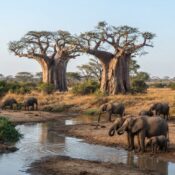
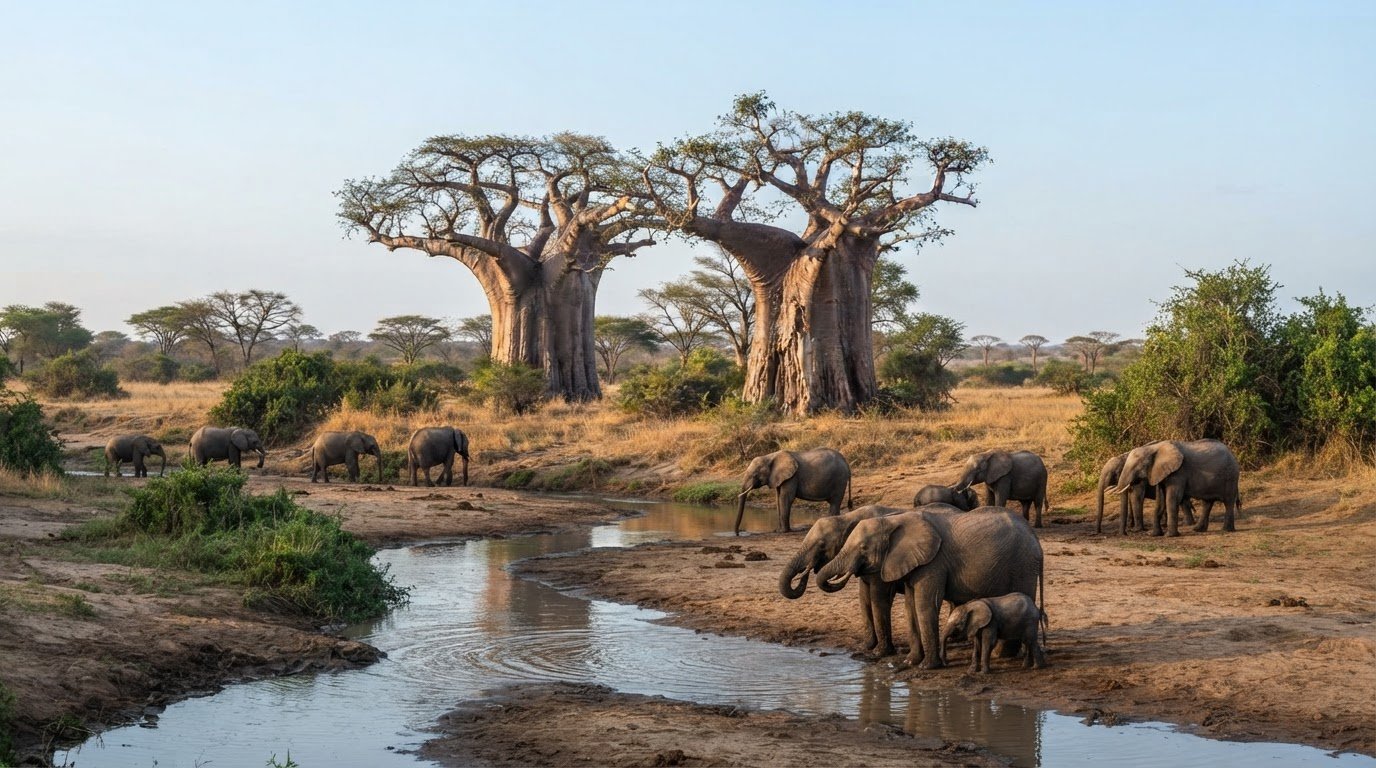
Elephants are among Tarangire’s most recognisable large mammals, and the river helps explain their seasonal presence. As water becomes scarce, herds are drawn toward the Tarangire River, where they can drink and move through a landscape also used by buffalo, zebra, and wildebeest. This shared wildlife setting makes a game drive about more than spotting elephants alone.
Herd size can be striking. Tarangire elephant herds can exceed 300 individuals, while the greater Tarangire ecosystem supports approximately 3,000 to 5,000 elephants seasonally. These figures describe different things: one refers to a herd, the other to elephants across the wider ecosystem. Seasonal movement also means the animals seen within the park can vary over the year.
Watching a herd offers a closer look at how elephants travel together. Young elephants stay among adults as the group moves between feeding areas and water. At the Tarangire River, a herd may pause to drink or cross open ground, giving visitors time to observe its size and movement from a vehicle. Patience matters, as the group may continue along its route.
The river is not the only feature shaping large-mammal sightings. Tarangire’s swamps and other water sources support wildlife across different parts of the landscape, while changing water availability influences where animals gather. Buffalo, zebra, and wildebeest also use these areas. Their presence alongside elephants shows how the park’s wildlife experience changes across habitats and seasons.
Tarangire National Park is part of a broader northern Tanzania circuit that can include Serengeti and Lake Manyara. Each park has its own landscape and wildlife patterns, so elephant sightings in Tarangire add a distinct part to a multi-park safari. For more detail on elephant size, location, and seasonal presence, explore this guide to Tarangire National Park elephants.
The park’s herbivores also make it relevant for predator sightings. Lions live in Tarangire National Park, and a game drive may pass through areas used by both large mammals and their predators. Sightings depend on where animals are moving and resting. The fringe-eared oryx, by contrast, is a rare dry-country antelope, showing that Tarangire’s wildlife includes more than its prominent elephant herds.
The Tarangire River offers a useful focus for understanding elephant movements, but the surrounding habitat matters too. A drive that takes in river edges, swamp country, and open areas offers different chances to observe elephants and other large mammals. The wider ecosystem’s seasonal elephant population also reminds visitors that wildlife does not follow park boundaries.
Baobabs, sausage trees, and termite mounds
Tarangire’s trees and termite mounds give its safari landscape a distinctive shape. Baobabs and acacias stand out across northern Tanzania, while sausage trees and raised mounds offer details to notice between wildlife sightings.
Baobabs and Acacia Trees
African baobabs are broad-trunked trees, while acacias are familiar features of Tarangire’s open woodland. Some baobab trees in the park are more than 300 years old, and their unusual forms make them easy landmarks during a drive. African baobab trunks can grow to around 30 metres in circumference and hold more than 100,000 litres of water. These details help explain why a baobab tree is more than a striking background feature.
Baobabs also give the landscape a strong sense of scale. Their wide trunks and branching crowns look different from the finer outlines of acacias, making the two easier to distinguish across open ground. The world has eight baobab species. A baobab outside Tarangire was found to be 1,275 years old, a reminder of the remarkable age these trees can reach, though that tree is not inside the park.
Sausage Trees and Termite Mounds
Sausage trees take their name from their long, sausage-shaped fruits, while termite mounds are raised structures built by termites. Both add distinctive forms to a Tarangire safari, especially when you look beyond the larger trees. Their shapes also offer useful visual markers: a mound rises from the ground, while sausage-tree fruit hangs from the branches.
These features make the park’s habitats easier to read. A game drive can pass from open ground into woodland, where tree shapes and termite mounds break up the view. During the rainy season, fresh growth can change the vegetation and partly obscure smaller landscape details. In drier conditions, tree and mound outlines may stand out more clearly against the ground.
For visitors travelling through northern Tanzania, Tarangire’s vegetation contrasts with the landscapes of Serengeti and Ngorongoro. Baobabs create a different profile from the familiar acacia canopy, while termite mounds add texture at ground level. Noticing these features brings the park’s scenery into focus, even between sightings of elephants, antelope, or birds.
Look first for the broad baobab trunk, then compare nearby acacias and scan the ground for termite mounds. A sausage tree’s hanging fruit offers another detail to spot. These simple observations make a drive through Tarangire’s varied habitats more engaging and show why the park is known for its distinctive scenery as well as its wildlife.
Park landscapes and habitats
Tarangire National Park covers about 2,850 square kilometres in northern Tanzania. Its landscape includes open grassland, woodland, the Tarangire River, and southern swamps, each offering different wildlife-viewing conditions.
These habitats matter because animals use them in different ways. Open areas make grazing herds such as wildebeest easier to notice, while denser vegetation can conceal wildlife from a moving vehicle. Woodland edges offer a useful contrast: scan both the open ground and the shade instead of watching only one part of the view. With its varied terrain, Tarangire offers changing scenery and different opportunities to observe wildlife.
Water shapes the southern swamps, including Silale Swamp, where visitors may see the Silale Swamp lion pride. Wild dogs are sometimes seen in these swampy areas too. After heavy rains, swamp routes can become unnavigable from late March to May. This affects where vehicles can travel, so viewing opportunities depend on ground conditions as well as which animals are present.
Vegetation also helps explain why sightings differ between habitats. Grassland offers open sightlines across feeding areas, while trees and thicker growth provide cover. The fringe-eared oryx is one example of an animal associated with Tarangire’s dry-country environment. Varied terrain rewards a slower scan: check open ground for movement, then look along vegetation edges where animals may be harder to see.
Tarangire’s landscape is best understood as a connected system, not a collection of separate scenes. Swamps, woodland, grassland, and river habitats each shape the park’s wildlife experience. Seasonal water and vegetation influence where animals feed or gather, while wet ground can limit access to some places. A Tanzania safari through Tarangire therefore offers more than one predictable viewing setting.
For a focused game drive, consider how habitat and access shape the route. The southern swamps offer distinctive wildlife-viewing opportunities, but heavy rain may affect vehicle movement. Elsewhere, open grassland and woodland provide different sightlines and cover. The key is that the best place to look changes with the landscape, season, and conditions on the ground.
BLS safaris
BLS safaris can help turn your interest in Tarangire’s wildlife and habitats into a well-planned Tanzania safari. Its tailor-made planning brings together route choices, local guidance, and handpicked lodges, with your wildlife interests and travel timing shaping the itinerary.
If you’re considering Tarangire alongside other destinations, BLS safaris can help plan a clear route through Tanzania or a wider East Africa journey . Share what you hope to see, such as elephant herds, birdlife, or varied landscapes, and discuss the kind of trip you have in mind.
Contact BLS safaris to talk through your safari plans.
Shape Your Safari Around What Matters Most
Let your wildlife priorities guide your choices. You might want more time to observe animals, explore varied habitats, or build a broader route through East Africa. Keeping those interests clear makes it easier to shape a safari around the experience you value, rather than trying to fit every possibility into one itinerary.
Tarangire National Park wildlife is one part of a wider regional journey. BLS Safaris offers East Africa Safaris, Uganda Safaris , and Kenya Safaris . Share the landscapes, wildlife, and pace you have in mind, and use those preferences as a starting point for planning your trip.
Your safari can begin with a clear idea of what you hope to discover. When you’re ready, take the next step and start shaping a journey that feels right for you.
Frequently Asked Questions
How do I get to Tarangire?
The usual road journey starts in Arusha and covers about 140 kilometres to Tarangire National Park. The drive takes around three hours, so allow for travel time when planning the day’s activities. Tarangire can be arranged as a stop within a northern Tanzania safari circuit. Your route and time in the park will depend on which other destinations you plan to visit.
How big is the park?
Tarangire National Park covers about 2,850 square kilometres. Its size means a safari route can include different habitats rather than one continuous type of scenery.
Tarangire Wildlife Guide: What Animals Can You See in Tarangire?
A guide to Tarangire National Park wildlife includes elephants, lions, buffalo, zebra, wildebeest, and distinctive antelope. The rare fringe-eared oryx and long-necked gerenuk are notable dry-country species. Leopards and cheetahs are rare, while wild dogs are very rare.
What wildlife is commonly seen in Tarangire National Park?
Elephants, buffalo, zebra, and wildebeest are among the mammals visitors may see. Lions are also present, while antelope add variety across the park. Viewing conditions differ on each game drive, so scan open ground as well as woodland edges. Grazing animals, for example, may be easier to spot in open areas, while wildlife can be harder to see in thicker vegetation.
How many elephants live in Tarangire National Park?
There isn’t one fixed number of elephants in the park because their movements are seasonal. The wider Tarangire ecosystem supports approximately 3,000 to 5,000 elephants seasonally, a figure that refers to the ecosystem rather than a year-round count inside park boundaries.
What birds are found in Tarangire National Park?
More than 500 bird species have been recorded in Tarangire National Park. The park’s wetlands, woodland, and open areas provide different places to look for birdlife. Swamps are especially interesting during the wet season, when they support bird activity. Bring binoculars if you have them, and take time to watch and listen rather than expecting every bird to appear in the open.
When is the best time to see wildlife in Tarangire?
July to November is a strong period for general wildlife viewing, while June to October is the dry season. These periods overlap, but the best choice depends on your priorities. For larger mammals gathering near water, plan around dry-season movement. If birds matter most, the wet season offers a different experience, with October to May a good birding period.
What wildlife can visitors see during the Tarangire dry-season migration?
From July to November, wildebeest, zebra, eland, Coke’s hartebeest, gazelle, buffalo, and elephants are drawn toward the Tarangire River. This movement reflects animals seeking water as seasonal sources become scarce. A drive during this period may reveal a mix of herds rather than a single migration group. The species you encounter depend on where animals are moving.