The lowest-looking quote isn’t always the best value. Masai Mara safari costs on the market typically range from US$942 to US$2,700 per person, and the difference often reflects experience level and package inclusions, not just trip length. A better comparison looks beyond the headline price.
It’s natural to focus on the total first, but two quotes for the same destination can cover different stays, transport and activities. A lower figure may leave important parts of the trip outside the package, while a higher one may reflect a different level of comfort or service.
This guide explains how park fees, seasons, transport, optional extras and package experience levels shape safari prices. You’ll learn what to look for in a quotation so you can compare the trip being offered, not just the total at the bottom.
Key Takeaways
- Compare the safari experience level, transport, accommodation and inclusions, not just the package total.
- Park entry fees can vary with the season, visitor category and where you stay, so their effect on the full trip depends on your itinerary.
- Travel dates matter: green-season and peak-season rates can differ for accommodation and safari packages.
- Optional activities, flights, transfers and tips can add to your trip budget; separate these from the package price when comparing quotations.
- A clear quotation makes it easier to see what your safari includes and choose an experience that fits your priorities.
How much does a Masai Mara safari cost?
Masai Mara safari costs depend on accommodation, trip length and transport, including whether the vehicle is private or shared. Compare the full itinerary and inclusions, because labels such as “budget” or “mid-range” don’t guarantee matching experiences.
Private Safari Prices by Tier
A private safari reserves the vehicle and guide for your travel party, while budget, mid-range and luxury describe different experience levels. These tiers matter because accommodation standards and services shape the package, not just the destination.
A 3-day budget road safari, a 3-day mid-range road safari and a 3-day luxury road safari are useful examples to compare. Keep the duration and route alike when reviewing them. Then consider how comfort, privacy and the style of wildlife viewing differ. A luxury package may include a different standard of accommodation, while a budget option may suit travellers who prioritise time in the reserve.
Private travel means your party has a dedicated vehicle arrangement rather than joining other travellers. For a Kenya safari, compare nights, driving time and game-viewing schedule alongside the tier name. These details help explain what each quote is designed to deliver.
Package Costs by Accommodation Budget
The accommodation budget describes the type and level of lodging included in the safari package. It matters because the stay is a core part of the trip when totalling up the Masai Mara costs, and different lodging choices can change the overall quotation.
Compare the accommodation, meal arrangements and location relative to the reserve in each option. A tented camp and a lodge can offer different styles of stay, even when both are described as mid-range. A package may also include nights in different places, so check how each one fits the route.
For a fair comparison, line up packages with the same number of nights and similar accommodation standards. A 4-day mid-range road itinerary, for example, is more useful beside another 4-day mid-range option than beside a short fly-in trip. Look for clear descriptions rather than relying on tier labels alone.
Sample Budgets for Couples and Families
A sample trip budget adds up the costs for each traveller and each included part of the itinerary. It matters because a couple and a family may divide shared transport costs differently, and their accommodation needs can also vary.
For a couple, compare a private 3-day itinerary with a shared trip of the same length, then note how the accommodation and transport differ. For a family, first match the number of travellers and nights across quotations. A safari van can carry up to 7 persons per vehicle, which can affect how a group shares transport costs.
Use the same trip outline for each example: nights, accommodation level, road or fly-in transport, and included activities. Separate optional extras from the package total. This helps couples and families see what the quoted budget covers, without treating a lower headline figure as a like-for-like deal.
What are the Masai Mara park fees in 2026-2027?
Masai Mara entry fees depend on the fee schedule, visitor status, season and accommodation location. Distinguish reserve entry from conservancy charges in each quotation.
Reserve Entry Fees by Visitor and Location
Reserve entry fees cover access to the Masai Mara National Reserve. Their stated amounts vary by visitor category, season and location, so the fee basis affects the total for each traveller and entry period.
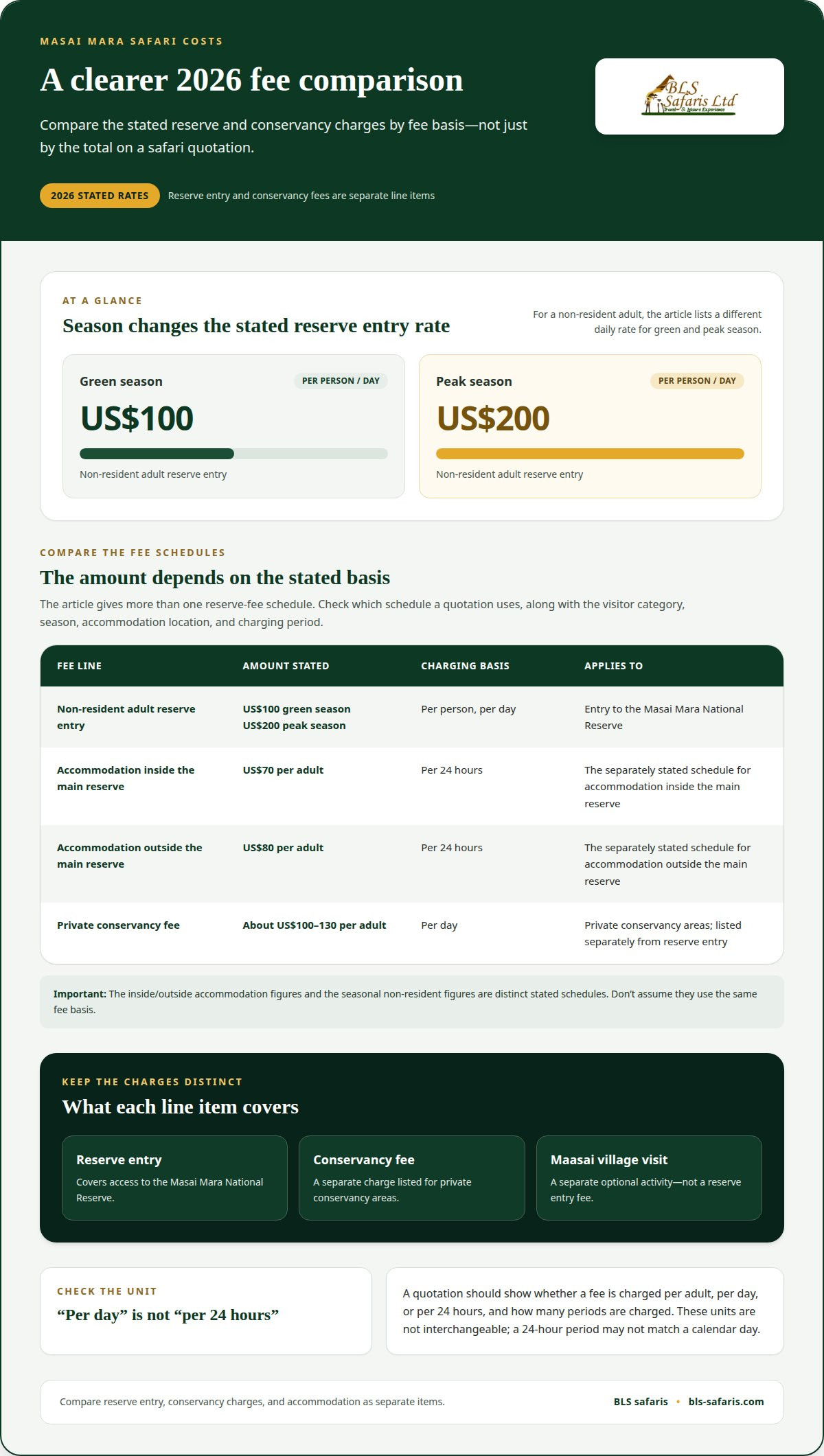
For 2026-2027, non-resident adult entry is listed at US$100 per person per day in the green season and US$200 in peak season. Always consider the season you are travelling when adding up the Masai Mara safari costs.
Reserve and Conservancy Fee Differences
A reserve entry fee covers access to the national reserve, while a conservancy fee is listed separately for private conservancy areas. If a stay or activity involves both areas, the quotation may show separate charges.
Private conservancy fees range between US$80 and 150 per adult per night depending on whether it is a child or adult. Don’t treat that amount as a replacement for the reserve entry fee: the fee depends on the area included in the itinerary. Ask for each charge to be shown by name, rate and charging period in the quote.
For a practical comparison, use the same traveller profile and itinerary for every quotation. A non-resident adult travelling during peak season can compare the listed US$200 daily entry rate with the schedule stated for their accommodation location. Keep the conservancy fee separate if the itinerary includes private conservancy access. This makes differences in quoted totals easier to trace.
Also note whether the charge applies per adult, per day or per 24 hours. Those units are not interchangeable: a 24-hour period may not match a calendar day in how a quotation presents the stay. For example, a two-night itinerary should show the entry-fee basis and number of periods charged, rather than only one combined amount.
Lodges and tented camps may be inside or outside the main reserve, so accommodation location can affect the listed entry amount. A Maasai village visit is a separate optional activity, not a reserve entry fee. Keep it separate from park and conservancy charges when reviewing the line items.
Because Masai Mara safari costs include more than entry, a clear quotation should separate reserve fees, conservancy fees and accommodation. If you’re shaping an itinerary around these charges, request a safari quotation with the travel dates and stay location.
Peak-season and green-season price differences
The season affects accommodation rates and can change the total cost of a Kenya safari. The wildebeest migration is described as running from July to September, while the Masai Mara peak season broadly covers July to October.
Green season in the Masai Mara is roughly April to June. Low-season Kenya safari packages typically cost 20-30% less than peak-season packages. That difference can make travel dates a major budget choice, especially when accommodation is a large share of the trip total. The exact saving depends on the package and its included services.
Accommodation prices show how seasons can shift a quote. These figures describe different accommodation categories, so compare like with like.
Kenya safari price categories also help explain seasonal differences. These broad market ranges are not fixed rates for every itinerary. The number of nights, private or shared arrangements, and accommodation choice all affect the final Masai Mara safari costs.
The season can also change reserve entry charges, so compare the fee period shown in each quotation with your travel dates. A peak-season package may combine higher accommodation charges with a different entry fee amount. Separate each cost line to see whether the difference comes from lodging, reserve access, transport or another part of the itinerary.
Package inclusions can vary, even for trips in the same season. Check whether the quotation lists accommodation, meals, game drives, road transport or flights, and reserve charges. Then note anything excluded, such as an optional activity or an onwards flight, rather than assuming it forms part of the total. Most full-service Masai Mara safaris include two to three game drives per day led by professional guides, but each quotation should state its own itinerary.
To compare lower-cost options, match trip length and accommodation level across green- and peak-season dates. A green-season option may cost less, while peak season aligns with the migration period. Weigh the seasonal difference against your priorities for wildlife viewing, flights and lodging before choosing dates.
Optional activities, tips, and other extras
Transport choices, optional activities and tips can change the total Masai Mara safari costs beyond the core itinerary. Separating these extras makes quotations easier to compare.
Road and Air Transport Costs
Road and air transport connect Nairobi with the Mara National Reserve but differ in travel time and cost. Road transfers take roughly five to six hours each way, while fly-in safaris reach the Mara from Nairobi within an hour.
Shared vehicles spread transport costs across travellers, while a private vehicle gives one party its own arrangement. A safari van can carry up to 7 persons per vehicle, and a shared van costs less per person per day depending on the number of people who will be using the van.
Optional Activities and Costs
Optional activities are experiences added to the game-drive itinerary. Their separate prices can help explain differences between quotations.
A Maasai village visit is another possible extra, costing about US$20-50 per person. Since activity prices are usually listed per traveller, a couple or family should consider the group total, not only the individual rate. Ask for each activity to appear as a separate line, so the core safari and the optional experience remain easy to distinguish.
Some activities also affect how the day is arranged. A balloon flight, for example, can be added to the trip, while a village visit is a cultural stop. Compare the listed activity, its price and the itinerary details rather than assuming an optional experience is part of the base package.
Tips and Other Extras
Tips and small additions are personal expenses that may sit outside the package total.
For a three-day example, that estimate works out to US$30 per person across the trip. Keep tips separate from quoted transport and accommodation, because they may not be included in the package price. A Maasai village visit should also remain a distinct activity line, rather than being confused with reserve or conservancy fees.
Before comparing two quotations, group extras into three categories: transport, activities and personal spending. List return flights, a balloon safari and tips separately. This clarifies the core Masai Mara safari costs and shows which additions are optional. Shared travel may lower each traveller’s share of the vehicle cost, while private transport keeps the vehicle dedicated to one group.
How can travelers compare and book a reliable Masai Mara safari at a lower cost?
Start with a like-for-like comparison, not the headline total. Match travel dates, nights, route, accommodation level and transport type across quotations. Then compare inclusions such as meals, reserve entry, game drives and transfers. A lower total may reflect fewer inclusions or a different itinerary, while a higher one may cover more of the trip. Focus on the value behind each figure.
Use the same traveller details for every quotation, including group size and whether the vehicle is shared or private. Record accommodation locations, as reserve charges can depend on where guests stay. Separate optional activities, flights and tips from core package costs to see which parts account for the difference. For example, compare two road itineraries with similar nights and lodging before weighing either against a fly-in option.
A reliable quotation describes the trip clearly. Look for named accommodation, transport arrangements, planned activities and a readable breakdown of inclusions and exclusions. A vague line such as “full safari package” doesn’t show whether meals, reserve access or airport transfers are covered. A detailed itinerary helps you understand what is arranged and makes changes easier to discuss before booking.
Booking route can affect the total, too. A market comparison indicates that booking through an international operator can cost 20% to 300% more than booking locally on a like-for-like basis. That range is wide, so compare the actual itinerary and inclusions rather than assuming every local quotation is cheaper or equivalent. Consider the communication, routing details and support described alongside the price, then weigh those against the trip you want.
To reduce Masai Mara safari costs without changing the trip’s purpose, consider flexible dates, a shared vehicle or a simpler accommodation level. Green-season travel may offer lower package rates than peak-season dates, while removing an optional balloon flight can reduce extras. Keep the reserve, nights and core wildlife-viewing time consistent as you compare. If a quotation changes several elements at once, separate those choices to see which adjustment delivers the saving.
Before choosing, make a comparison table with dates, nights, accommodation, transport, fees, included activities and exclusions. Mark each item as included, separate or not part of that itinerary. This helps uncover differences hidden by a single total and gives you a clear basis for choosing a package that fits your budget and priorities.
BLS safaris
BLS safaris plans tailor-made Kenya safaris around your travel dates, preferred accommodation and wildlife-viewing priorities. Its itineraries include permits, transport, lodging and meals, with transparent pricing and no hidden fees. Request a quote that reflects the details you’ve compared.
Share your preferred season, group size, trip length and accommodation level to shape an itinerary around your plans. For a wider journey, BLS safaris also plans East Africa safaris, Uganda safaris and Tanzania safaris. Planning includes local guidance and support from enquiry through travel.
Contact BLS safaris to discuss your safari plans and request a tailored quote.
Plan a Safari That Fits Your Priorities
Use your comparison to decide what matters most: more time for wildlife viewing, a particular accommodation style, or a route that includes other destinations. That choice gives your planning a clear starting point. Rather than searching for one “best” package, focus on the experience you want and the trade-offs you’re comfortable making. This makes the next step more useful than comparing Masai Mara safari costs alone.
When you’re ready to turn those priorities into a trip, BLS Safaris can plan a Kenya safari as part of a wider East Africa journey. Share your preferred travel dates, group details and the experience you have in mind to get started.
A thoughtful plan starts with what matters to you. Take the next step when you’re ready, and build from there.
Frequently Asked Questions
How do Kenya Safari Costs Compare with Other African Safaris?
Safari prices across Africa depend on the destination, trip length, accommodation and transport. Compare similar itineraries, such as a Kenya wildlife trip and a Tanzania wildlife trip, rather than headline prices alone. Check whether each quotation covers the same number of nights, park visits and meals. A package total reflects its route and included experiences, so a fair comparison starts by matching those details.
Is it cheaper to drive or fly to the Masai Mara?
Driving can cost less when travellers share a vehicle, while flying saves travel time. The road transfer from Nairobi takes roughly five to six hours each way; flights reach the Mara within an hour. For a group, divide the road vehicle cost among travellers before comparing it with each person’s flight fare. The better-value option depends on group size, schedule and how much time you want for the safari itself.
Is it cheaper to stay in the reserve or a conservancy?
Neither location is always cheaper overall; accommodation and access charges both affect the total. Private conservancy fees are about US$100-130 per adult per day, while reserve entry fees use a separate schedule. A tented camp inside the reserve and a lodge in a conservancy may have different nightly rates and fee arrangements. Compare the complete stay, including access charges, rather than deciding from the accommodation location alone.
What is the average cost of a Masai Mara safari per person?
On the market, safari packages typically range from US$942 to US$2,700 per person, with a median of about US$1,800. This is a broad benchmark, not a fixed price for every itinerary. Masai Mara safari costs vary with trip length, accommodation and transport. A per-person total may also change with private or shared travel, so use the market range as context and compare quotations with similar plans.
How much do Masai Mara safari packages cost by budget, mid-range, and luxury tier?
These are broad market ranges, not set rates for every trip. The tier alone doesn’t define the experience: compare accommodation, route, vehicle arrangement and inclusions. A mid-range package with more nights or a different route may cost more than a shorter luxury option.
What are Masai Mara National Reserve entrance fees for international visitors?
For non-resident adults in 2026-2027, the listed entry fee is US$100 per person per day in green season and US$200 per person per day in peak season. Budget for each adult and each day of reserve access. For example, a couple’s daily entry total uses two adult fees. Keep this line separate from accommodation and conservancy charges when working out the full trip budget.
How much do Masai Mara park fees cost for children and residents?
Children’s and residents’ fees depend on their visitor categories, so don’t apply the non-resident adult rate to every traveller. Build the estimate with separate entries for each traveller category and the relevant reserve access period. For a family with adults and children, list the categories individually in the budget. This makes the total easier to interpret and prevents adult international visitor rates from being mistaken for everyone’s fee.
What is included in a Masai Mara safari package, and what costs extra?
Package inclusions vary by itinerary. BLS Safaris itineraries include permits, transport, lodging and meals, with transparent pricing and no hidden fees. Optional activities, such as a balloon safari or Maasai village visit, can add to a trip total, and tips are another personal expense. Read the quotation’s inclusions and separate optional experiences from the core itinerary to see what the package covers and what you choose to add.