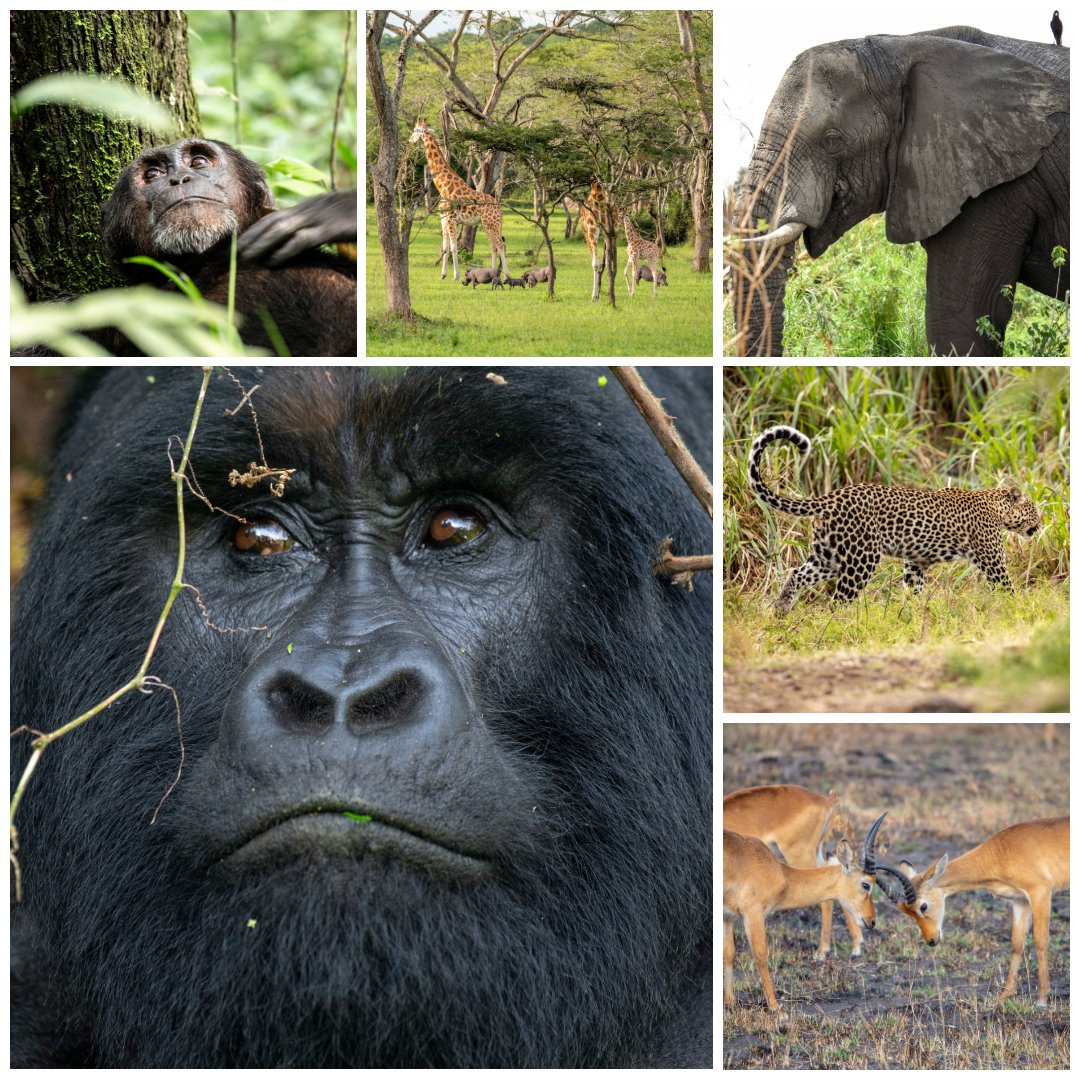
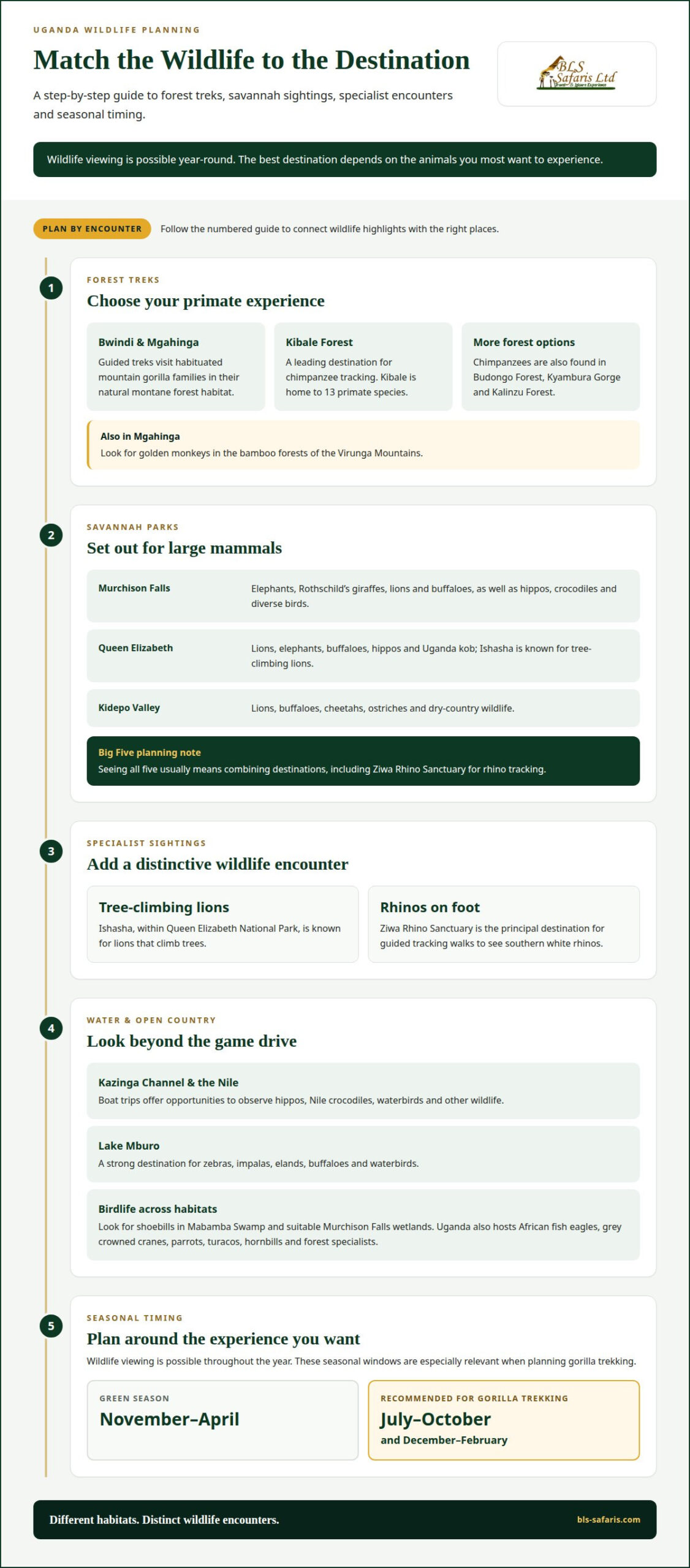
Animals on a Uganda Safari range from mountain gorillas in Bwindi and Mgahinga to chimpanzees in Kibale, tree-climbing lions in Ishasha, hippos on the Kazinga Channel and rhinos at Ziwa. Wildlife viewing is possible year-round. The green season runs from November to April, while gorilla trekking is recommended during the drier periods of July to October and December to February.
It makes sense to wonder when sightings are best, especially if you hope to see particular animals. The right timing depends on what you most want to experience: a forest trek and a game drive bring different conditions and wildlife encounters.
This guide explains which animals you can see in each of Uganda’s national parks, forests and sanctuaries, what else you may encounter along the way, and how the seasons can shape your trip. You will also find practical planning guidance, from chimpanzee tracking in Kibale to mountain gorilla trekking in Bwindi and Mgahinga.
Key Takeaways
- Uganda combines Big Five game viewing with distinctive forest experiences, including mountain gorilla, chimpanzee and golden monkey tracking.
- Queen Elizabeth and Murchison Falls national parks are key destinations for lions, elephants, buffaloes, leopards and other savannah wildlife.
- Ishasha is known for tree-climbing lions, while Ziwa Rhino Sanctuary is the principal destination for seeing rhinos on foot.
- Seeing all five members of the Big Five usually requires combining destinations, including a visit to Ziwa for rhino tracking.
- Uganda is also an outstanding birding destination, with shoebills, African fish eagles, grey crowned cranes, parrots, hornbills and forest specialists.
Top Animals on Uganda Safari by Destination at a Glance
Uganda’s wildlife is spread across distinct places, so the animals you see depend on the destinations you choose. This overview lists the top animals on a Uganda safari, park by park, before the detailed sections below.
| Destination | Wildlife highlights |
|---|---|
| Murchison Falls National Park | Elephants, giraffes, lions, leopards, buffaloes, hippos, crocodiles and diverse birds |
| Queen Elizabeth National Park | Lions, including tree-climbing lions in Ishasha, elephants, buffaloes, leopards, hippos and Uganda kob |
| Bwindi Impenetrable National Park | Mountain gorillas, forest monkeys and specialist forest birds |
| Kibale Forest National Park | Chimpanzees and other forest primates |
| Mgahinga Gorilla National Park | Mountain gorillas, golden monkeys and montane forest wildlife |
| Lake Mburo National Park | Zebras, impalas, elands, buffaloes, giraffes and waterbirds |
| Kidepo Valley National Park | Lions, buffaloes, cheetahs, ostriches and dry-country wildlife |
| Ziwa Rhino Sanctuary | Southern white rhinos on guided tracking walks |
Each of these places offers a different kind of encounter. Linking several parks in one route brings far more variety than staying in a single area. For help choosing, see the best national parks to visit on a Uganda safari.
Wildlife Highlights: Animals on a Uganda Safari
Mountain gorillas, chimpanzees and other primates
Mountain gorillas are among Uganda’s most distinctive wildlife experiences. Bwindi Impenetrable National Park and Mgahinga Gorilla National Park offer guided treks to habituated gorilla families in their natural montane forest habitat. Kibale Forest National Park is the leading destination for chimpanzee tracking, while further opportunities exist in Budongo Forest, Kyambura Gorge and Kalinzu Forest.
Mgahinga is also the best place to look for golden monkeys, which inhabit the bamboo forests of the Virunga Mountains. Depending on the habitat and destination, forest walks may also reveal black-and-white colobus monkeys, red-tailed monkeys, blue monkeys, vervet monkeys and olive baboons.
Savannah mammals, aquatic wildlife and herbivores
Animals on a Uganda Safari are not limited to primates or the Big Five. Alongside the Big Five, Uganda’s savannah parks support a wide range of large mammals. Murchison Falls National Park is especially associated with Rothschild’s giraffes, elephants, lions and buffaloes. Uganda kob are common on open grasslands in Queen Elizabeth and Murchison Falls, while Lake Mburo is particularly good for zebras, impalas, elands, buffaloes and waterbirds. Depending on the park, you may also encounter waterbucks, topis, hartebeests, bushbucks, reedbucks, oribis and other antelopes.
Boat trips add an aquatic dimension to a Uganda safari. Hippos rest in rivers and lakes, while Nile crocodiles bask along the banks. The Kazinga Channel in Queen Elizabeth National Park and the Nile in Murchison Falls National Park offer strong opportunities to observe hippos, crocodiles, waterbirds and other wildlife from the water.
Birds you can see on a Uganda safari
Besides animals on a Uganda safari, there are also birds. Uganda is an outstanding birding destination, with species ranging from wetland birds to forest specialists. The shoebill is one of the country’s most sought-after birds and is often searched for in Mabamba Swamp and suitable wetland habitats around Murchison Falls. Lakes, rivers and wetlands are also good places to look for African fish eagles, whose calls and fishing behaviour are memorable safari experiences.
The grey crowned crane, Uganda’s national bird, is recognisable by its golden crown and elegant appearance. Forested parks support colourful parrots, turacos and hornbills, as well as numerous Albertine Rift forest birds. The habitat, time of day, season and length of your visit all influence which species you encounter.
1. Chimpanzees in Kibale Forest National Park
Kibale Forest National Park is one of Uganda’s key places to see chimpanzees in their natural forest habitat. It is also home to 13 primate species, making a visit about more than one encounter. Chimpanzees are the main draw, while other primates add variety to time spent among Kibale’s trees.
Chimpanzee trekking focuses on finding a troop in the forest. Some chimpanzees in Kibale have been habituated to human presence, which allows visitors to observe them at close range. The animals still move through their habitat, so the encounter involves following their activity rather than watching from a fixed viewing point. In June 2025, a visitor spent two hours with a troop in Kibale Forest National Park.
Patience matters during a chimpanzee trek. Chimpanzees may be moving, feeding, resting or interacting as visitors observe them. Keep your attention on the group and follow your guide’s directions. A quiet, attentive approach makes it easier to watch their behaviour.
Kibale’s other forest primates can be harder to spot. They are shy and spend much of their time high in the canopy, where leaves and branches can obscure the view. Scan the treetops as well as the forest floor, and look for movement rather than expecting every animal to stay visible. Chimpanzees are generally easier to see than these elusive primates.
Chimpanzees are also found in other Ugandan forests. Budongo Forest, linked with Murchison Falls, and Kyambura and Kalinzu, linked with Queen Elizabeth National Park, appear in several safari routes, so you can pair chimpanzee tracking with savannah wildlife.
Mountain gorillas and chimpanzees are both great apes, but seeing them means visiting different habitats. Kibale is known for chimpanzee trekking, while mountain gorilla trekking takes place in Bwindi Impenetrable National Park and Mgahinga Gorilla National Park. If both experiences matter to you, plan around these separate forest destinations.
To prepare for Kibale, make chimpanzees the focus of your forest visit and allow time to notice the wider primate habitat. The Kibale chimpanzee tracking and primate forest experience is a useful reference for understanding the park’s appeal.
2. When is the best time for wildlife viewing in Uganda?
The best time for wildlife viewing in Uganda must be considered when discussing animals on a Uganda safari. Wildlife viewing in Uganda depends on the habitats and animals you want to see. Uganda’s green season runs from November to April, while gorilla trekking is recommended during the drier periods of July to October and December to February. For savannah drives, forest walks and boat trips, choose travel dates around your priorities and allow time to reach each habitat.
Uganda’s national parks and wildlife habitats each have their own highlights. Kibale Forest National Park is known for chimpanzees, Bwindi and Mgahinga for mountain gorillas, and Queen Elizabeth National Park for savannah wildlife and the Kazinga Channel. Murchison Falls National Park offers savannah game drives and boat trips, and Ziwa Rhino Sanctuary offers rhino viewing.
Queen Elizabeth National Park’s Kazinga Channel is a strong choice for hippo viewing. The channel is 32 km long and is commonly estimated to support around 2,000 hippos. A boat trip gives you a water-level view of hippos, waterbirds and other animals along the banks. Pair it with a game drive to see elephants, buffalo, lions and Uganda kob in the park’s savannah.
Murchison Falls National Park adds another savannah and river setting. Game drives there can bring elephants, lions and buffalo, while boat trips offer a different view of animals along the water. Its route is often combined with chimpanzee tracking in nearby forest.
The Big Five are elephant, lion, leopard, buffalo and rhinoceros. Uganda offers opportunities to see all five, but completing the experience usually means combining destinations. Elephants, lions, leopards and buffaloes occur in the main savannah parks, especially Queen Elizabeth and Murchison Falls, while Ziwa Rhino Sanctuary is the principal destination for seeing southern white rhinos on foot. Leopards are elusive and difficult to spot, and Queen Elizabeth’s Ishasha sector is particularly known for tree-climbing lions, although sightings are never guaranteed.
Compared with Kenya or Tanzania, Uganda offers a distinctive mix of savannah wildlife and forest encounters. Chimpanzees and mountain gorillas complement classic game viewing, while Queen Elizabeth National Park combines savannah drives with hippo-rich waters. Uganda suits a trip that brings primate tracking together with national parks and varied habitats.
Uganda’s national animal is the Uganda kob, an antelope found in open grassland. Look for it on savannah drives, particularly in protected areas where grassland supports grazing wildlife.
Pay attention to your guide’s instructions in every park. Keep a respectful distance from animals and stay with your group on forest walks. Around the Kazinga Channel, watch hippos from the boat and follow the crew’s safety guidance.
To plan a route around Uganda’s national parks, wildlife habitats and preferred travel season, consider a tailored Uganda safari that connects the places you most want to visit.
3. Dry-season and green-season wildlife viewing
The season also tells us alot about animals on a Uganda safari. The animals you will see with depend on wether you are visisting in the dry or green season. Uganda’s green season runs from November to April, bringing a different feel to wildlife viewing. Rather than treating one season as suitable for every activity, match your timing to the habitats you want to experience. A game drive in Queen Elizabeth National Park, a boat trip on the Kazinga Channel and a forest trek in Kibale each involve different viewing conditions.
In greener months, thicker vegetation can make animals less exposed during a drive. Scan clearings, grassland edges and paths near water. In Kibale Forest National Park, look for movement in the canopy as well as signs of chimpanzees moving through the forest. A slower pace helps you notice smaller details.
Rain can also change the feel of a forest walk. On trails in Kibale or Bwindi Impenetrable National Park, take steady steps and follow your guide’s route over uneven ground. Pack for changing conditions and protect your camera equipment.
Drier periods can suit visitors who want to combine several activities across Uganda. A route might link savannah drives in Queen Elizabeth National Park with chimpanzee tracking in Kibale, then continue to Bwindi for a gorilla trek. These experiences take place in different habitats, so travel time between parks and the order of stops matter as much as the season.
Mountain gorilla trekking is recommended during the drier periods from July to October and December to February. This timing can make forest trails more manageable, though the trek still follows the terrain and the gorillas’ movements. In Bwindi and Mgahinga, prepare for a guided walk, not a fixed viewing point.
Use the season as one planning factor, not the only one. Start with the animals you most hope to see, then choose parks and activities that suit them. For example, combine a Kazinga Channel boat outing with nearby game drives, or pair Kibale’s forest experience with another destination. For more on timing, see this guide to planning a Uganda wildlife safari around seasons, rivers and regions.
Pack practical layers, comfortable walking shoes and protection for your equipment, especially if your plans include both forest and savannah. In Queen Elizabeth National Park, alternate time on the water with land-based viewing; in Kibale, leave room for a careful forest walk.
4. Tree-climbing lions in Ishasha
Ishasha, in the southern part of Queen Elizabeth National Park , is known for lions resting in trees. Seeing a lion above the ground creates a different kind of game-drive encounter from spotting one in open grassland. Lions have been seen lounging about 20 feet above the ground, where their outline can blend with branches and leaves.
During a drive through Ishasha, scan the trees as well as the surrounding grassland. Look carefully along sturdy branches, especially where foliage creates shade. A lion’s tawny coat can be difficult to distinguish against dry leaves, so move your gaze slowly instead of searching only for movement. Your guide can help identify shapes and suggest where to look.
Tree-climbing lions are a distinctive wildlife highlight, but they remain wild animals in their natural habitat. A quiet, patient drive gives you time to observe the landscape. Bring binoculars if you use them, and keep your camera ready without letting photography distract you from your guide’s directions.
Ishasha works well as part of a wider visit to Queen Elizabeth National Park. The setting changes what to scan for: tree branches in Ishasha, open ground and Uganda kob on savannah drives, and hippos along the Kazinga Channel on a boat outing. Itineraries such as the 5 Day Queen Elizabeth Ishasha Safari show how these places fit together.
Allow enough time for careful observation on the Ishasha drive. Ask your guide what they are looking for, then follow their cues when they pause or change direction. A branch that looks empty from one angle may reveal an animal from another.
Respectful viewing matters around Ishasha’s lions. Stay with the vehicle, follow your guide’s instructions and keep noise low as the group watches. Avoid calling to animals or trying to draw their attention.
For anyone interested in the animals on a Uganda safari, Ishasha adds a memorable tree-canopy perspective to classic game viewing. Look across the branches, grassland and surrounding habitat, and let your guide lead the search.
5. Mountain gorilla trekking in Bwindi and Mgahinga
Mountain gorilla trekking adds a forest encounter to Uganda’s varied wildlife experiences. The main destinations are Bwindi Impenetrable National Park and Mgahinga Gorilla National Park. These parks offer opportunities to see mountain gorillas in their natural habitat. For a closer look at options, read where you can go gorilla trekking in Uganda.
Bwindi is home to nearly half of the world’s mountain gorillas across four sectors. Your choice of sector shapes where the trek begins and the forest route your group follows. The walk takes place in a living habitat, so terrain and the gorillas’ movements influence the experience. Mgahinga offers another Ugandan setting for a gorilla trek.
A census in 2018 counted 459 mountain gorillas in the Bwindi-Sarambwe ecosystem, out of 1,063 counted overall. These figures offer context for the ecosystem’s importance. Your outing is a guided search through forest, not a visit to an enclosed viewing area.
Uganda’s gorilla trekking rules include a daily group limit: permits are limited to eight visitors per gorilla family per day. This cap keeps each viewing group small. Follow your guide’s instructions throughout the trek, stay with the group and observe the gorillas calmly.
Prepare for the trek itself. Bwindi’s forest terrain calls for comfortable walking shoes and clothing suited to a guided hike. Carry only what you need, and listen closely as your guide explains the route. The trek’s pace and length depend on where the gorillas are moving.
A close encounter can be deeply memorable, but the forest remains the gorillas’ habitat. In Bwindi, visitors have seen mountain gorillas from just a few feet away; distance and visibility vary with the group’s movements and vegetation. Give the animals space, avoid sudden movements and let your guide manage the viewing position.
If gorillas and other wildlife are both priorities, plan a route that connects forest trekking with other habitats. Bwindi or Mgahinga can anchor the primate portion of a trip, while Queen Elizabeth National Park adds savannah and wetland viewing, and Ziwa Rhino Sanctuary adds rhinos. See also how to combine gorilla trekking with game drive safaris.
BLS safaris: East Africa Safaris
BLS safaris can bring Uganda wildlife experiences together in a route shaped around the animals and habitats you want to see. If you are choosing between chimpanzee tracking in Kibale, a gorilla trek in Bwindi or Mgahinga, and game viewing in Queen Elizabeth National Park, thoughtful planning can connect these priorities in one Uganda safari. Local guidance, clear routing, handpicked lodges and transparent pricing help you see how the journey fits together.
Turn to BLS safaris when you are ready to move from choosing wildlife highlights to planning a complete trip. Alongside Uganda safaris, the company plans East Africa, Kenya and Tanzania safaris, with options for travelers considering a wider regional journey.
Contact BLS safaris or visit bls-safaris.com to discuss your safari plans.
Shape Your Safari Around What Matters Most
Use your wildlife priorities to guide your next planning decision. Whether you are interested in forest-dwelling primates, savannah wildlife or both, think about how you want each day to feel. Your preferred pace, travel dates and time between destinations can all help shape a practical itinerary.
Before settling on a route, decide which encounter matters most and which experiences would complement it. BLS safaris can turn those priorities into a tailored plan, whether you are considering Uganda or a wider East African journey.
Start with the experience you are most excited about and build from there.
Frequently Asked Questions
When is the Best Time for Wildlife Viewing in Uganda?
For gorilla trekking, the recommended drier periods are July to October and December to February. For a broader wildlife trip, choose dates based on your main activities and park route. If you are combining forest walks with savannah drives, allow for different terrain and conditions at each stop.
What animals can you see on safari in Uganda?
Animals on a Uganda safari can include mountain gorillas, chimpanzees, golden monkeys, lions, leopards, elephants, buffaloes, hippos, crocodiles, rhinos, giraffes, zebras, antelopes and Uganda kob. Birds may include shoebills, African fish eagles, grey crowned cranes, parrots, hornbills and forest specialists. The mix depends on the parks in your itinerary: Kibale is known for chimpanzees, Mgahinga for golden monkeys, Ishasha for lions resting in trees, Murchison Falls for giraffes and savannah wildlife, and Ziwa for rhinos.
Where are the best national parks in Uganda for wildlife viewing?
Choose Murchison Falls National Park for elephants, giraffes, lions, buffaloes, hippos, crocodiles and diverse birds; Queen Elizabeth National Park for lions, elephants, buffaloes, hippos and Uganda kob; Kibale Forest National Park for chimpanzees and other primates; Bwindi Impenetrable National Park or Mgahinga Gorilla National Park for mountain gorillas; Lake Mburo for zebras and antelopes; Kidepo Valley for dry-country wildlife; and Ziwa Rhino Sanctuary for guided rhino tracking.
What animals can you see in Queen Elizabeth National Park?
Queen Elizabeth National Park is known for hippos along the Kazinga Channel and tree-climbing lions in Ishasha. Its savannah also offers elephants, buffalo and Uganda kob. A boat outing offers a different perspective from a game drive, with wildlife visible along the water and banks.
Where can you see mountain gorillas and chimpanzees in Uganda?
See chimpanzees in Kibale Forest National Park and plan a separate trek for mountain gorillas in Bwindi Impenetrable National Park or Mgahinga Gorilla National Park. These encounters take place in different forest areas, so allow for travel between destinations.
When is the best time of year to see wildlife in Uganda?
Uganda’s green season runs from November to April, and gorilla trekking is recommended during the drier periods of July to October and December to February. Wildlife presence does not guarantee a sighting: habitat, time of day, season and the length of your visit all affect what you encounter. Choose based on your priorities rather than assuming one period suits every park.
How safe is a Uganda safari, and what wildlife risks should visitors know?
Follow your guide’s instructions, keep a respectful distance from animals, stay with your group on forest walks, and remain inside the vehicle on game drives unless directed otherwise. Around the Kazinga Channel, watch hippos from the boat and follow the crew’s safety guidance; hippos can reach speeds of up to 30 mph on land. For more detail, read whether it is safe to travel to Uganda for a gorilla and wildlife safari.