Uganda Safari Planning works best when you choose a manageable circuit, group nearby parks and lakes, and treat long drives as travel days. A comfortable mix of primate and wildlife experiences can fit into 10 to 14 days.
This Uganda Safari Planning guide explains why Uganda suits a safari, how its parks and lakes connect, and how to shape a two-week route. Uganda is home to more than 1,000 bird species, alongside forests, wildlife parks and lakes, so the route matters as much as the destinations. You will also see where to build in slower stops and which long drives call for an overnight break. For a wider view, see this three-country journey guide.
Key Takeaways
- Good Uganda Safari Planning connects parks and lakes in a logical route.
- Route guidance recommends avoiding driving days longer than 5-6 hours where possible.
- Use Lake Bunyonyi and Lake Mburo to shape a southern route, and allow time for the return to Entebbe.
- Build Queen Elizabeth National Park around wildlife viewing and a Kazinga Channel boat activity.
- Choose the stops that matter most, then leave room in your two-week plan for travel time.
1. Why Go on Safari in Uganda?
Uganda brings forest trekking, savannah wildlife, birding, and lakeside rest together in one journey. Uganda Safari Planning can pair gorilla trekking in Bwindi Impenetrable National Park with wildlife viewing and time beside a lake. Start with the experiences that matter most, then group nearby stops to reduce backtracking.
The country suits travellers who want more than game drives. Uganda has over 1,066 bird species, and Kibale Forest National Park is home to 13 primate species. Visitors can add chimpanzee trekking, guided forest walks, hiking, or birding to a wildlife itinerary. At Queen Elizabeth National Park, the Kazinga Channel offers a different view of the landscape and its wildlife.
Kibale gives chimpanzee trekking its own place in the route. Allow time for the trek rather than treating it as a quick stop between long drives. Pairing Kibale with nearby nature walks makes the forest portion feel distinct from gorilla trekking in Bwindi.
Balance active days with quieter ones. After trekking in Bwindi or Kibale, a lakeside stay offers a gentler pace before the next park. Birders may want more time for observation, while hikers can prioritise forest trails and guided walks. A practical route gives each interest enough room.
How do Uganda gorilla trekking permits work, and how far ahead should they be booked? Book well in advance. Build the permit date into your route first, then arrange nearby stays and travel days around it. Read more in our guide on Gorilla Trekking permits in Uganda and Rwanda.
A Uganda tourist visa costs US$50, according to the Directorate of Citizenship and Immigration Control, Uganda . An East Africa tourist visa costs US$100. Uganda national park fees are $40 per person for 24 hours as of Sept 2025. Accommodation costs depend on lodge standard and location, and safari budgets change with route and activities.
Should you book with a tour operator or travel independently? An operator can coordinate permits, lodging, and routing across distant parks, while independent travel gives you more control over each decision. Uganda Safari Planning is especially useful when you want to combine gorilla trekking, Kibale chimpanzees, and relaxation without compressing every day. A tailor-made East Africa safari itinerary can connect those priorities into a workable sequence.
2. Lake Bunyonyi, Lake Mburo, and return to Entebbe
Lake Bunyonyi and Lake Mburo make a useful southern Uganda pairing, but their order shapes your itinerary. From Lake Mburo to Lake Bunyonyi or Lake Mutanda, the drive is about 240 kilometres and takes five to six hours. Treat this as a travel day, not a quick transfer. It leaves less room for a full park visit on the same day.
From Bwindi Impenetrable Forest, Lake Bunyonyi is about a three-hour drive. It makes a natural pause after trekking before you continue towards Lake Mburo. If Kibale comes earlier in your route, check whether the southern lakes fit your direction or would mean doubling back. A logical sequence preserves time for the places you want most. See the 4 Day Lake Mburo Lake Bunyonyi Safari for one example.
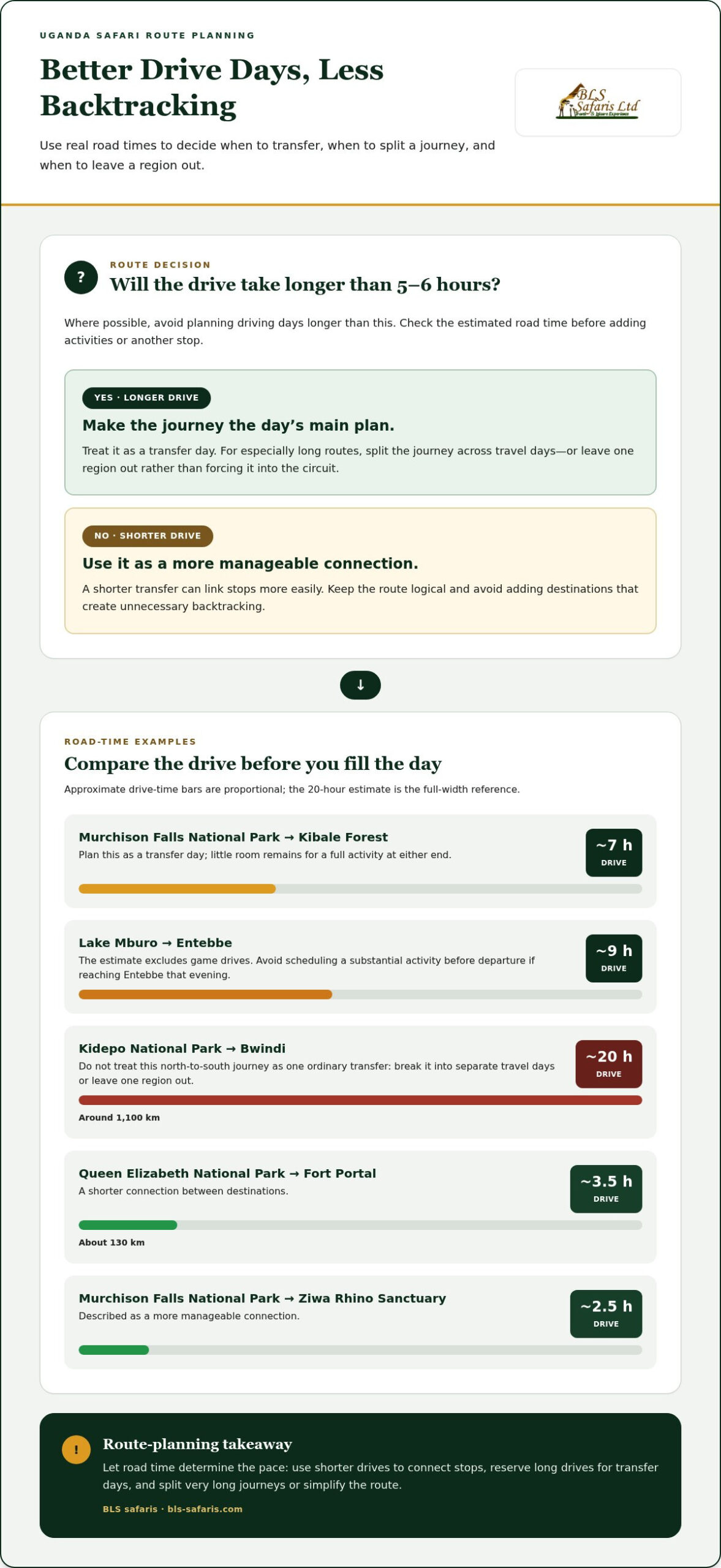
The return drive from Lake Mburo to Entebbe is estimated at nine hours, excluding game drives. Avoid a substantial activity before departure if you need to reach Entebbe that evening. For a relaxed itinerary, add an overnight stop on the way back, or keep the final park visit light. Let your flight time and planned stops shape the last travel day.
Entebbe is also the practical starting point for journeys towards Kampala and Jinja. Entebbe to Jinja is about 80 km and can take around four hours when traffic around Kampala is heavy, so allow flexibility. A first night near Entebbe separates arrival logistics from the drive east, while a Jinja stop adds a different pace before heading to Murchison Falls National Park.
For the return, compare Entebbe with the drive from Bwindi to Kigali, estimated at three to four hours. Kigali may suit an itinerary ending in Rwanda, while Entebbe fits a route returning to Uganda’s main international airport. Choose your endpoint before planning the final leg.
Keep a buffer between your last long drive and an international departure. The drive from the accommodation area to Entebbe International Airport is estimated at 30 minutes, excluding game drives, but that does not replace the time needed to reach the area from Lake Mburo. For help shaping the route around your dates, share your Uganda safari itinerary priorities.
3. Long-distance driving and travel-day planning
Uganda Safari Planning works best when road time shapes the itinerary. The drive from Murchison Falls National Park to Kibale Forest takes about seven hours, leaving little room for a full activity at either end. Plan it as a transfer day. The drive from Murchison Falls to Ziwa Rhino Sanctuary takes about two and a half hours, a more manageable connection.
Compare distances as well as drive estimates. Queen Elizabeth National Park to Fort Portal is about 130 kilometres and takes around three and a half hours. The road from Kidepo National Park in the north to Bwindi in the south is around 1,100 kilometres, about 20 hours of driving. Break it into separate travel days or leave one region out.
A practical rule is to avoid driving days longer than five to six hours where possible and not to schedule a day above 300 kilometres. Bwindi to Entebbe takes more than nine hours, so a same-day international departure leaves little room for delays.
The season also affects the journey. Commonly used dry-season travel periods are June to September and December to February. The southern region’s dry season runs from June through August, while the northern region’s runs from December through February. If your itinerary crosses both regions, account for these differences.
Rain can affect road conditions and transfer times, so leave flexibility around long drives and your gorilla trek. Mountain gorillas are a key reason to visit Bwindi, but getting to the forest is part of the journey. Avoid a tight connection immediately after a remote park.
What are the main risks of Uganda safari travel, including weather, wildlife and road delays? Long drives, changing road conditions, weather, and wildlife encounters can all affect the day’s schedule. Follow your guide’s instructions around wildlife and allow flexibility between destinations.
4. Queen Elizabeth National Park and Kazinga Channel
What are the best Uganda safari routes and national parks for a first-time visitor? Consider combining Murchison Falls National Park, Queen Elizabeth National Park, Kibale and Bwindi if time allows. The route brings together savannah wildlife, forest activities, and gorilla trekking. Our guide to the best national parks to visit on a Uganda safari offers more detail.
At Queen Elizabeth National Park, plan time for both land-based wildlife viewing and the Kazinga Channel. Allow time for the boat excursion alongside other park activities. A boat trip also gives the itinerary a change of pace from driving.
Ishasha is a sector of Queen Elizabeth National Park, not a separate park to add casually. The drive to Ishasha is estimated at two hours, excluding game drives. Include it if the southern sector’s wildlife fits your route, and allow time for activities after arrival. If your schedule is tight, focus on fewer sectors.
How do Murchison Falls, Queen Elizabeth, Bwindi and Kibale compare? Murchison Falls and Queen Elizabeth suit savannah wildlife viewing, with a boat activity on the Kazinga Channel at Queen Elizabeth. Bwindi is associated with mountain gorilla trekking, while Kibale is known for chimpanzee trekking in the forest.
Route timing matters because park activities and drives compete for time on the same day. On a western route, place Queen Elizabeth between Kibale and Bwindi, then decide whether Ishasha fits the southern section. Plan arrival times around activities, not just distances on a map.
Choose your activities before fixing overnight stops. Set aside enough time for the Kazinga Channel boat trip, then fit wildlife viewing around the rest of the day. A focused plan leaves room to enjoy the park instead of ticking off locations.
6. The remote perspective of Kidepo Valley National Park
Kidepo Valley National Park adds a genuinely remote perspective to Uganda Safari Planning. Its position in the far north means the park works best as a dedicated part of the itinerary rather than a quick addition to a western circuit. The distance creates a slower, more spacious safari experience focused on the park itself.
Plan Kidepo with enough time to appreciate the change of pace. The journey from Kidepo to Bwindi in the south is around 1,100 kilometers and about 20 hours of driving, so it should be divided into separate travel days or replaced with a different regional plan. Avoid placing Kidepo between tightly scheduled activities elsewhere in Uganda.
Choose Kidepo when its remote setting and northern landscapes matter more to you than fitting every major park into one trip. A dedicated Kidepo itinerary can stand on its own, or you can combine it with selected destinations while keeping the long connections visible in your route. The 4-day luxury Uganda safari in Kidepo shows one way to give the park focused time.
5. Planning a two-week route through Uganda
A two-week Uganda safari can balance primate trekking, savannah wildlife and lakeside rest. The recommended range for combining primate and savannah experiences is 10 to 14 days, with about 12-13 days presented as an ideal itinerary. Uganda Safari Planning starts by choosing priorities, then fitting destinations around travel time.
For a broad first visit, sketch a westbound circuit from Entebbe through Murchison Falls National Park, Kibale, Queen Elizabeth National Park and Bwindi. Finish near Lake Bunyonyi or Lake Mburo before returning to Entebbe. This links waterfall and savannah landscapes with chimpanzee and gorilla trekking, but involves substantial driving. The Murchison Falls to Kibale drive alone takes about seven hours. The 14 Day Uganda Wildlife Gorilla Safari shows how such a circuit can look.
A workable 14-day outline reserves arrival and departure time, with two nights near Murchison Falls, time for Kibale, and several nights across Queen Elizabeth and Bwindi. Add a lake stop if it matters more than an extra park activity. Treat this as a framework, not a packed checklist.
If Bwindi is a priority, make the gorilla trek date the anchor for your route. Arrange nearby accommodation to avoid an unnecessary transfer before trekking. Schedule Kibale around chimpanzee tracking, and avoid arriving late after a long drive. In Queen Elizabeth, decide which sectors matter most before choosing where to stay.
Murchison Falls is the northern outlier on this western route. Keep it if the falls and wildlife matter to you, while allowing for its long connection to Kibale. If a slower pace matters more, focus on Kibale, Queen Elizabeth, Bwindi and a lake.
Not every significant place fits into two weeks. Visiting most of Uganda’s important destinations is estimated to take around 22-25 days, so a two-week plan involves prioritising. Keep daily drives manageable, avoid stacking full activities onto transfer days, and consider an overnight stop when a long journey divides two key areas.
Use this sequence: choose your must-see parks, place trekking dates, connect regions in one direction, then remove stops that make the days too tight. Good Uganda Safari Planning delivers variety without covering the whole country.
BLS safaris: East Africa Safaris
BLS safaris helps turn your Uganda Safari Planning priorities into a connected itinerary, balancing park visits, trekking and travel days. Our Uganda Safaris bring together destinations such as Kibale, Queen Elizabeth and Bwindi, while East Africa Safaris suit travelers planning a wider regional journey. Local guidance and clear routing shape the trip around the experiences that matter to you.
If your plans extend beyond Uganda, Kenya Safaris and Tanzania Safaris offer options for a broader East African journey. Share your preferred parks, activities and pace, and contact BLS safaris or visit bls-safaris.com to start planning.
Shape your Uganda journey around what matters most
The strongest Uganda safari route reflects your priorities, not simply the longest list of destinations. Before settling on dates, decide what you most want to experience, which travel days you are comfortable with, and where you would like a slower pace.
Thoughtful Uganda Safari Planning gives you a practical starting point, while local guidance helps bring the details together into a trip that feels like your own. When you are ready, start planning at your pace.
Frequently Asked Questions
Why Go on Safari in Uganda?
Uganda suits travelers who want wildlife, primates, birding and cultural experiences within one trip. The country has 65 distinct tribes and over 1,066 bird species. Choose your main interest first, so it guides the route and pace.
Is one week in Uganda enough?
One week can work for a focused safari, but it is tight for combining gorilla trekking, chimpanzee tracking and wildlife viewing. Prioritize one main trekking activity and a nearby park rather than crossing the country for several stops.
Do you need a 4×4 for this Uganda itinerary?
Build the route and driving conditions into your vehicle decision, especially for independent travel and routes through parks or remote areas.
How Many Days Do You Need in Uganda?
Allow 10 to 14 days for a comfortable mix of primate trekking and savannah wildlife, with about 12-13 days presented as an ideal itinerary. If time is shorter, remove destinations before compressing activity days.
How many days are needed for a Uganda safari, and what itinerary works best?
For a broad safari, plan around two weeks and follow one direction through the country. A westward itinerary can connect Murchison Falls, Kibale, Queen Elizabeth and Bwindi, while a shorter trip can focus on fewer parks.
What is the best time of year to visit Uganda’s national parks?
Commonly used dry-season travel periods are June to September and December to February. Match your dates to your chosen parks and allow flexibility around forest trekking and road transfers.
How do you plan a route between Entebbe, Kampala, and Uganda’s safari parks?
Separate arrival logistics from the first substantial park transfer. Entebbe to Jinja is about 80 km and takes around four hours when there are no traffic jams around Kampala. Then arrange parks in a logical sequence, avoiding unnecessary returns through Kampala.
How long are the drives between Uganda’s main safari destinations, and what are road conditions like?
Fort Portal to Budongo Eco Lodge is estimated at 280 kilometers and about six hours. Mabamba Swamp to Lake Mburo is estimated at 215 kilometers and about five hours. Rain can affect road conditions, so treat estimates as planning guides and keep longer transfers clear of major activities.